

The Next Wave of the AI Super Cycle
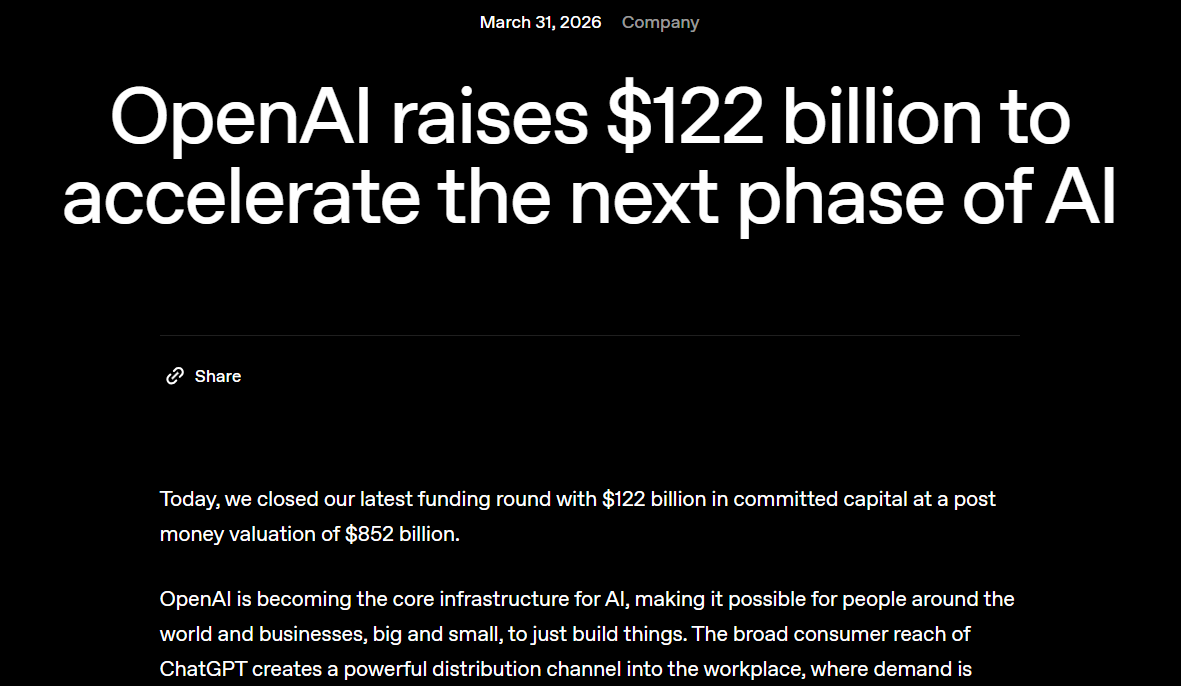
The AI buildout has been given the green light to continue in full force, with OpenAI raising a massive $122 billion at a whopping $852 billion valuation.
This has tremendous implications for the whole industry. It shows, in one way or another, that:
Internal developments are most likely far more advanced than what the public has access to. I speculated that the public release of Blackwell-trained models will trigger another aggressive rally in the AI industry. I would say there’s a high chance these private investors have already gotten a taste of this early AGI-like capability and have become extremely excited about it.
The largest backers of the AI cycle are more bullish than ever, and the capex race isn’t slowing down anytime soon. You don’t deploy billions of dollars into a private AI company unless you believe you’re going to outperform public market returns. If they expect OpenAI to appreciate significantly, you can also expect its developers and customers to require much more compute.
Semiconductor bottlenecks
However, you can only demand what can be supplied, and there are massive bottlenecks across the industry.
This is going to create a major opportunity for companies that are correctly positioned.
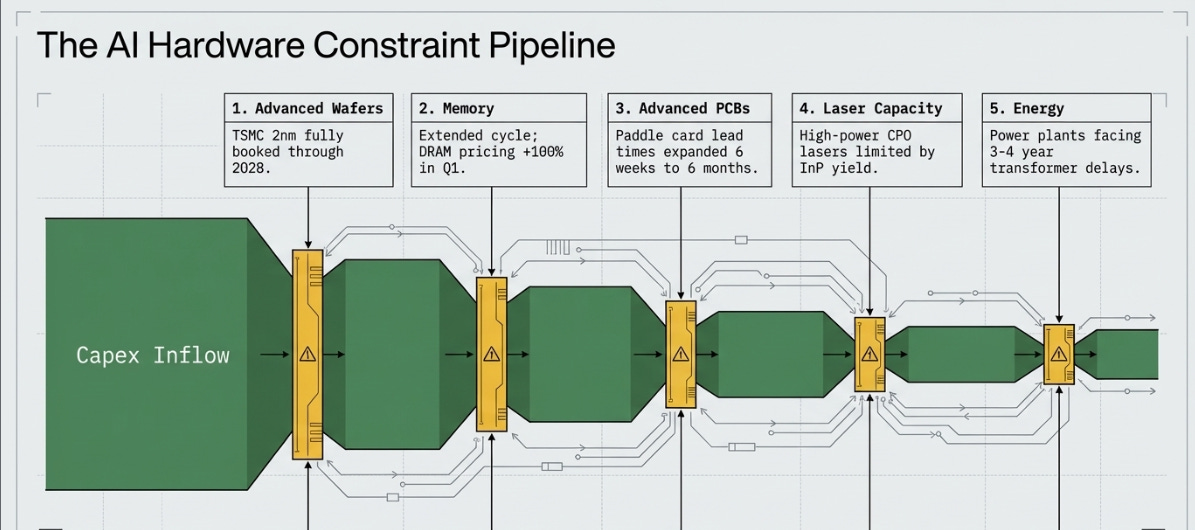
At a press conference in Taipei on March 24, Natarajan Ramachandran, Director of Product Marketing for Physical Layers at Broadcom, pointed out that the three main bottlenecks in the AI supply chain are currently:
1. Paddle cards / small advanced PCBs
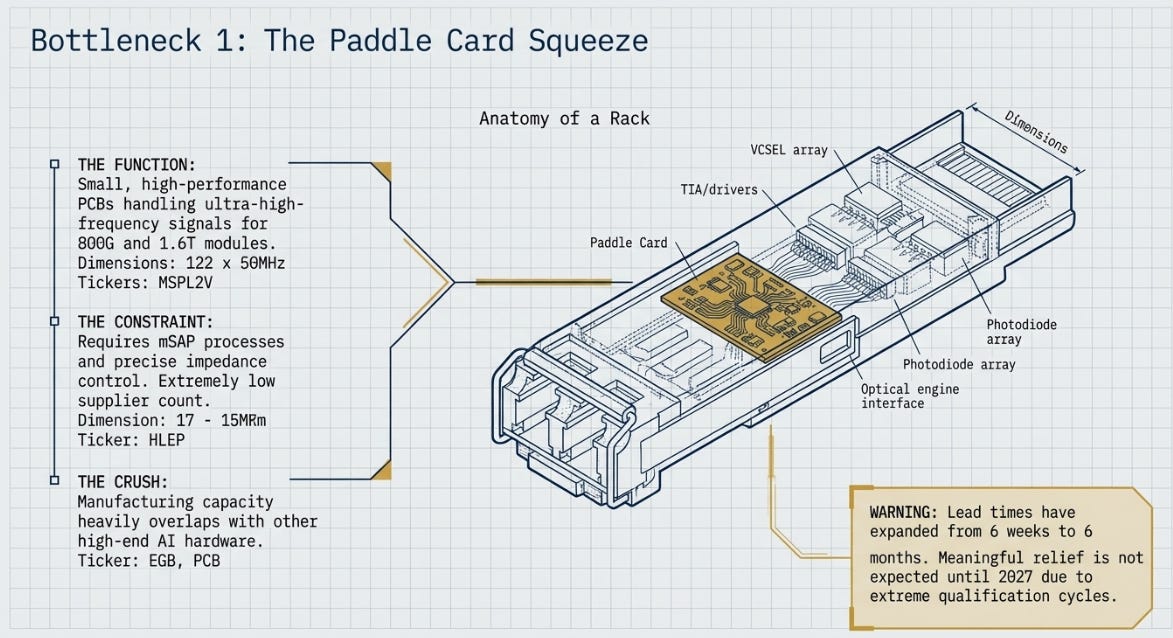
One of the clearest bottlenecks is the paddle card, the small high-performance PCB used inside optical transceivers such as 800G and 1.6T modules.
These boards are significantly harder to manufacture than standard PCBs because they must handle extremely high-frequency signals in a very small footprint, while maintaining very low loss and precise impedance control. This requires advanced processes like mSAP, along with specialized materials and manufacturing expertise that only a limited number of suppliers possess.
Another factor increasing the severity of this bottleneck is that the same manufacturing capacity overlaps with other high-end AI hardware. As demand for advanced server components rises, paddle cards get squeezed.
Lead times have already expanded from around six weeks to six months, with relief not expected until 2027. On top of that, large customers cannot easily switch suppliers due to long qualification cycles, which further tightens available capacity.
Companies
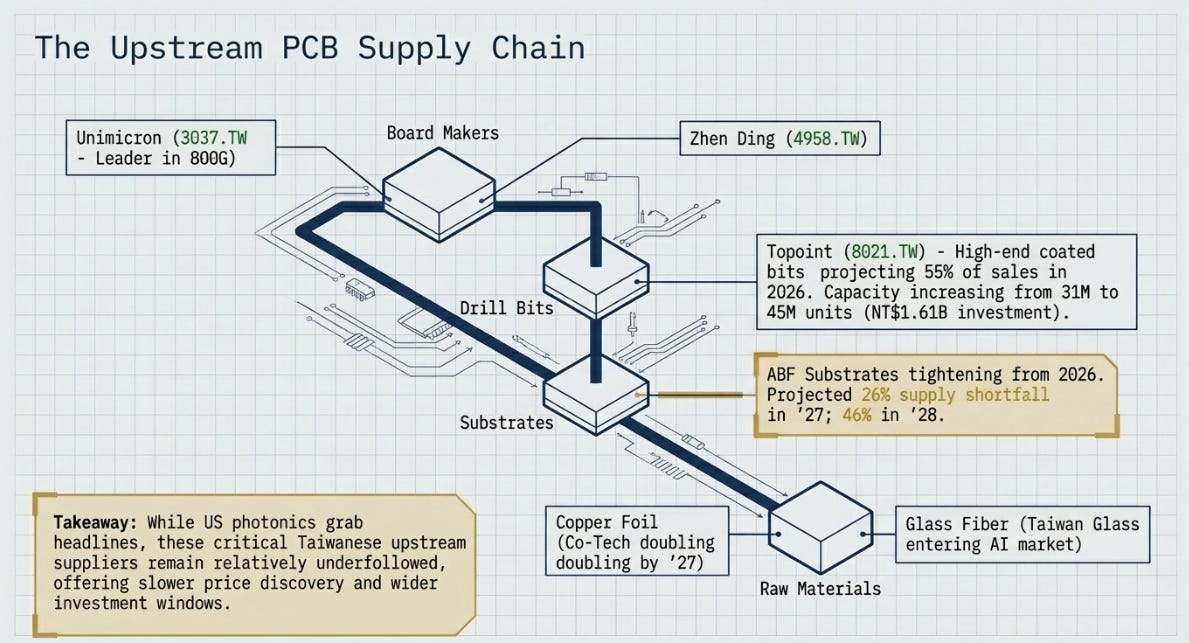
The leader in the PCB space is Unimicron (3037.TW), one of the main suppliers of boards for 800G optical modules and switches.
As next-generation applications such as AI servers continue to push PCB size, layer count, and material requirements higher, demand has surged across the upstream supply chain. Key materials such as fiberglass cloth, copper foil, and drill bits are already showing signs of tight supply, affecting IC substrates, networking, and server board production.
In response, Taiwan’s upstream suppliers are launching large-scale capacity expansions:
Elite Material Co. (EMC) plans to expand capacity by 70% over three years starting in 2024
Co-Tech is expected to double copper foil capacity by 2027
Taiwan Glass and Fulltech Fiber Glass (FFG) are entering high-end AI fiberglass markets, reshaping a space previously dominated by Japanese suppliers
For low CTE fiberglass cloth, Unimicron expects initial relief as early as Q4 2026, supported by new capacity from Nittobo and qualification of second-tier suppliers.
PCB leaders such as Zhen Ding Technology (4958.TW) and Unimicron expect a decade-long expansion driven by cloud and edge AI demand. Applications such as AI servers, smart glasses, and humanoid robots are key drivers of output growth.
To capture this opportunity, the PCB supply chain is entering another CapEx cycle. Companies are:
Acquiring land and building new plants in Taiwan
Upgrading manufacturing equipment
Expanding into Southeast Asia to capture de-China supply chain shifts
At the same time, companies historically focused on consumer and automotive electronics, such as Compeq and Tripod Technology, are aggressively expanding into high-end AI-related capacity.
This surge in demand is also extending lead times for key equipment such as back-drilling machines and AOI systems, now reaching three to six months.
The shortage will also impact other players in the ecosystem, including:
Zhen Ding Technology (4958.TW)
Gold Circuit Electronics (2368.TW)
Dynamic Holding (3715.TW)
Apex International (4927.TW)
AT&S
Although some of these names have already seen strong share price appreciation, there are likely second-order beneficiaries and underfollowed winners, making this a highly interesting segment to research further.
Ongoing capex expansion driven by AI servers and HPC is increasing demand for related components. As a result, drill bit and drilling services are expected to become the main revenue driver.
For example, Topoint, a PCB drill bit manufacturer, noted that supply of high-end coated drill bits remains tight due to rising demand from PCB customers.
Topoint projects that high-end coated drill bits will account for up to 55% of sales in 2026, exceeding the 2025 record of 48% and well above the 2022–2024 average of ~30%.
To meet demand, the company is executing a large-scale expansion plan:
New factory in Zhongli
Investment of ~NT$1.61B in high-end production lines
Capacity increase from 31M units in Q1 2026 to 45M units by year-end
While photonics has been receiving most of the attention, largely due to US-listed companies, these Taiwanese names remain relatively underfollowed. That leads to slower price discovery, creating potential opportunities for investors willing to go deeper into the supply chain.
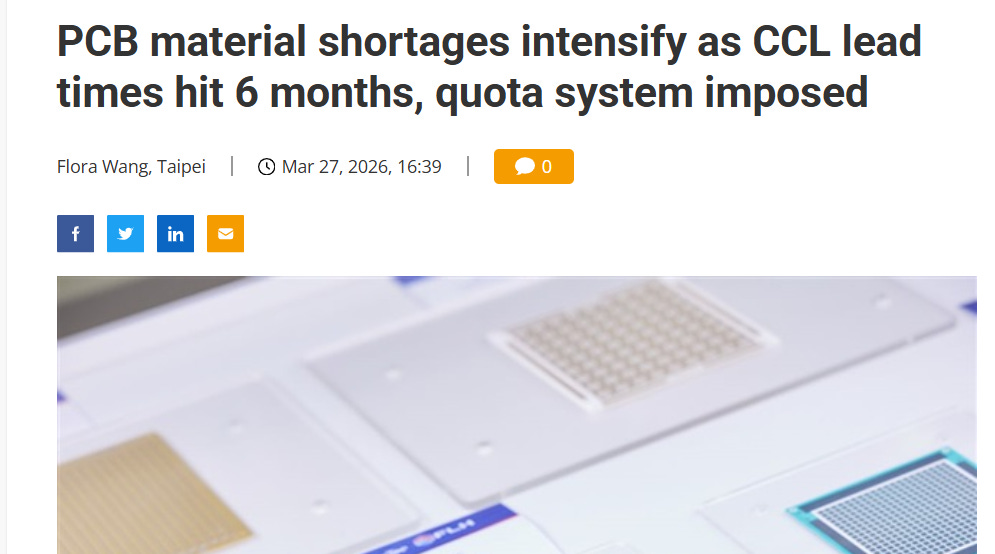
Advanced materials shortage
Shortages of high-end materials and substrates are expected to intensify from 2H26 onward. More specifically, ABF substrates are set to tighten from 2026 as AI chip die sizes expand, with supply shortfalls projected to reach 26% in 2027 and 46% in 2028.
Here are all the companies involved across key parts of the supply chain:
Copper foil
Co-Tech Development (8358.TWO)
Nan Ya Plastics (1303.TW)
Taiwan Copper Foil, subsidiary of Mitsui Mining & Smelting (5706.T)
Glass fiber / glass cloth
Nittobo (3110.T)
Taiwan Glass (1802.TW)
Fulltech Fiber Glass (1815.TWO)
CCL / prepreg
Elite Material (2383.TW)
Nan Ya Plastics (1303.TW)
ABF substrates / IC substrates
Ibiden (4062.T)
Unimicron (3037.TW)
Nan Ya PCB (8046.TW), subsidiary of Nan Ya Plastics (1303.TW)
Kinsus (3189.TW)
AT&S (ATSV.VI)
Samsung Electro-Mechanics (009150.KS)
ABF film
Ajinomoto (2802.T)
Drill bits
Topoint (8021.TW)
PCB / board makers
Zhen Ding (4958.TW)
Gold Circuit (2368.TW)
Dynamic (3715.TW)
Unimicron (3037.TW)
Nan Ya PCB (8046.TW), subsidiary of Nan Ya Plastics (1303.TW)
As you can see, there are many names to analyze to find undervaluation.
The problem with these bottleneck trades is that institutions and insiders usually identify them early. By the time the thesis reaches the public, share prices have often already moved significantly. At that stage, it’s still difficult to quantify the upside, so the investment case lacks clarity.
There’s also the risk of pricing dynamics working against you. Increased volumes don’t always translate cleanly into revenue, since supply and demand dynamics are hard to model with precision.
By the time the opportunity becomes clear and measurable, a large part of the upside has already been captured. Combined with the lower information transparency of many supply chain companies, it becomes harder for retail investors to identify opportunities early, though not impossible.
In the next article, I’ll go through these names in detail to identify whether any stand out from a valuation perspective.
2. Laser capacity
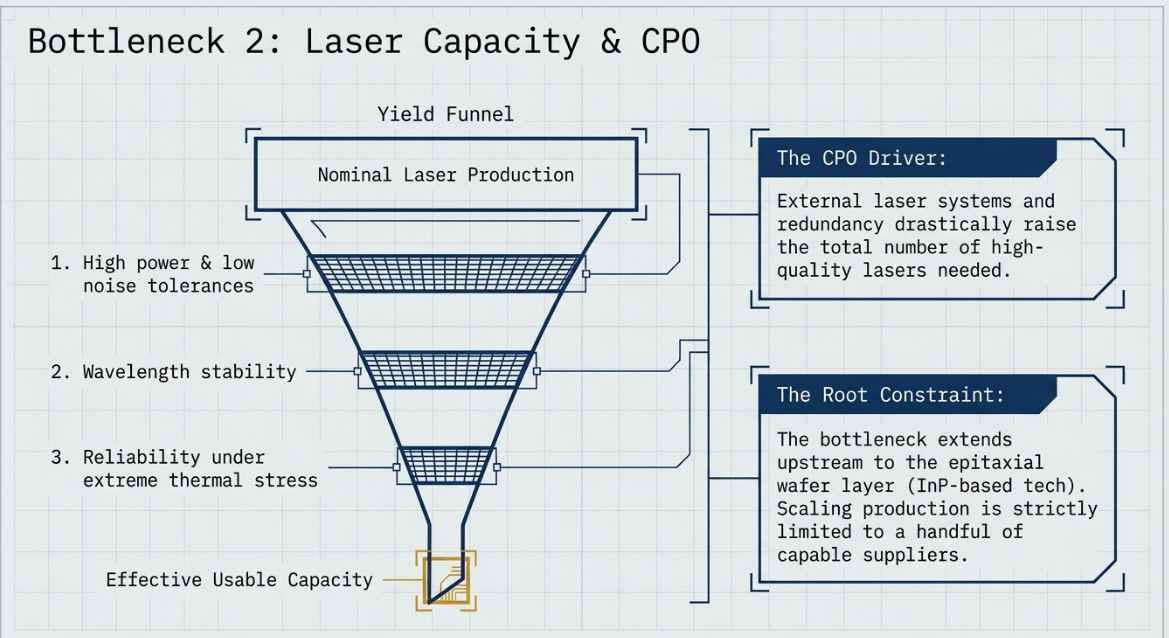
The second bottleneck is laser supply, particularly high-end lasers required for CPO and next-generation optical interconnects.
The issue is not just producing laser diodes, but producing lasers that meet the strict requirements of AI data centers: high power, low noise, wavelength stability, and reliability under thermal stress.
Many companies can manufacture lasers broadly, but far fewer can deliver the exact specifications required at scale for advanced networking.
This is further constrained by low yields after reliability testing, meaning effective usable capacity is much lower than nominal production.
CPO architectures can increase laser demand faster than expected, as external laser source systems and redundancy requirements raise the number of high-quality lasers needed. Since these systems rely heavily on InP-based technology, and only a limited number of suppliers can scale production, the bottleneck extends from finished components all the way upstream to the epitaxial wafer layer.
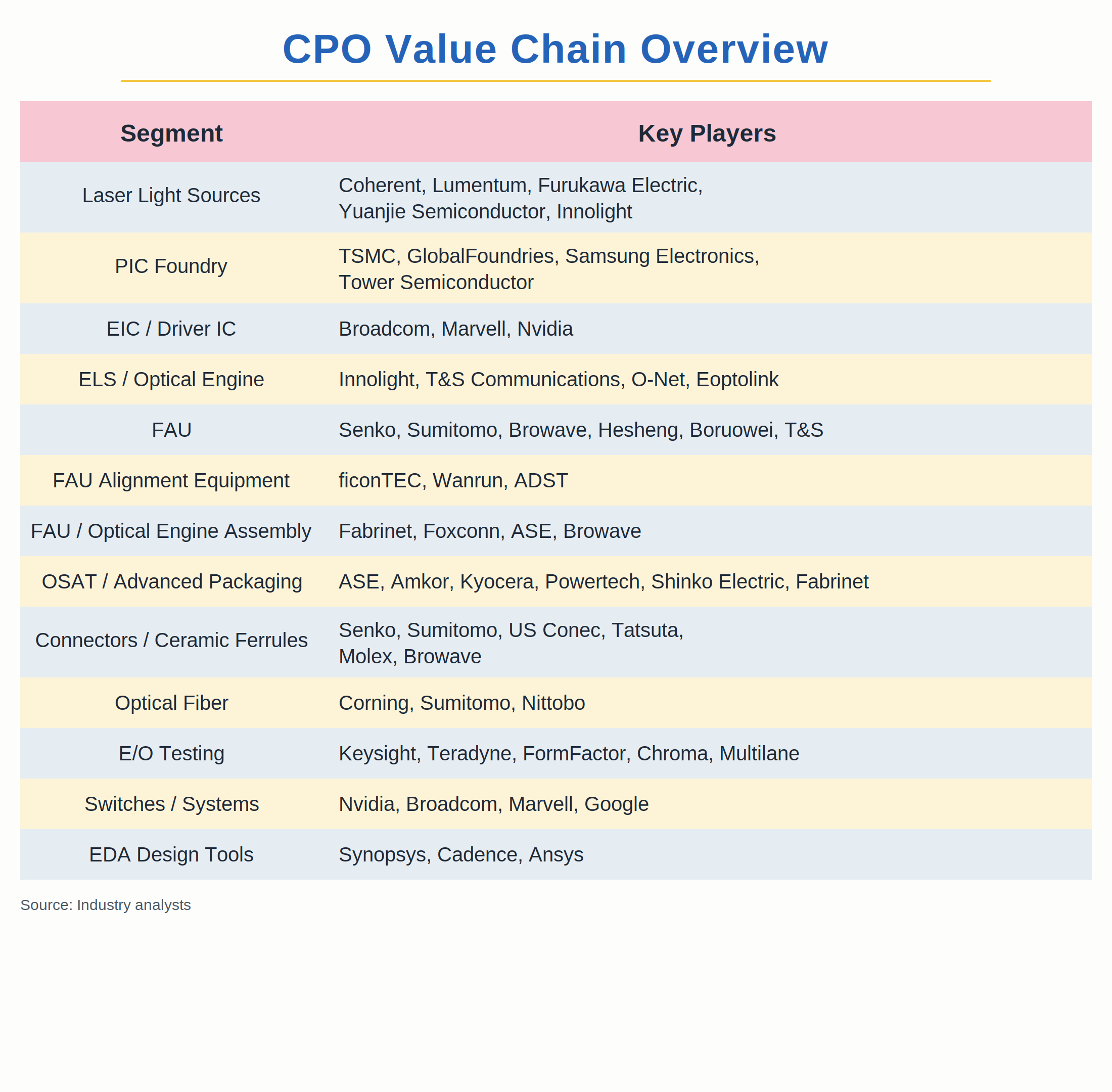
Companies by product
EMLs
Laser and modulator on one InP die. Used in the highest-performance optical links, mainly 800G and 1.6T datacenter transceivers.
Lumentum: major 100G / 200G EML supplier for datacenter optics.
Coherent: 200G EML supplier for 1.6T and higher-speed roadmaps.
Mitsubishi Electric: supplier of 200Gbps EML devices for next-generation optical transceivers.
Applied Optoelectronics
CW / DFB source lasers
Continuous-wave source lasers. Used when modulation is done elsewhere, usually on silicon photonics, CPO, or another external optical engine.
Lumentum: major supplier of CW source lasers for SiPh and CPO.
Coherent: supplier of CW InP lasers, including high-power versions for CPO and SiPh.
Applied Optoelectronics: supplier of high-power CW lasers for external-light-source architectures.
Sivers Semiconductors: supplier of CW / DFB lasers and arrays for 800G, 1.6T, CPO, and optical I/O.
ELS / ELSFP
External laser source in a pluggable module. Used to keep the laser outside the hot package in CPO / NPO systems.
Applied Optoelectronics
Lumentum
Coherent
Sivers Semiconductors
InP substrates
Base wafer material for many of these lasers. Upstream exposure to the same bottleneck.
AXT: public supplier of InP wafer substrates used in AI optical interconnects.
Sumitomo Electric / Sumiden: major supplier of InP substrates.
Laser-integrated PIC / InP-on-silicon
Laser integrated onto the photonic platform.
OpenLight
Tower Semiconductor
GlobalFoundries
ELS / CPO optical connectors
Optical connectors for remote-laser CPO systems.
SENKO: supplier of ELSFP host and module connectors.
Lumentum
Lumentum is the main supplier of high-power narrow-linewidth lasers to NVIDIA.
The only other company able to produce lasers with similar performance is Broadcom, which makes Lumentum the only pure-play name with very high exposure to NVIDIA’s aggressive CPO adoption.
Lumentum is undoubtedly the highest-quality bet in the space. However, it is trading at 19x NTM sales, so the valuation already reflects that quality.
Lumentum now sees a possible mid-term run rate of between $1.25B and $2B.
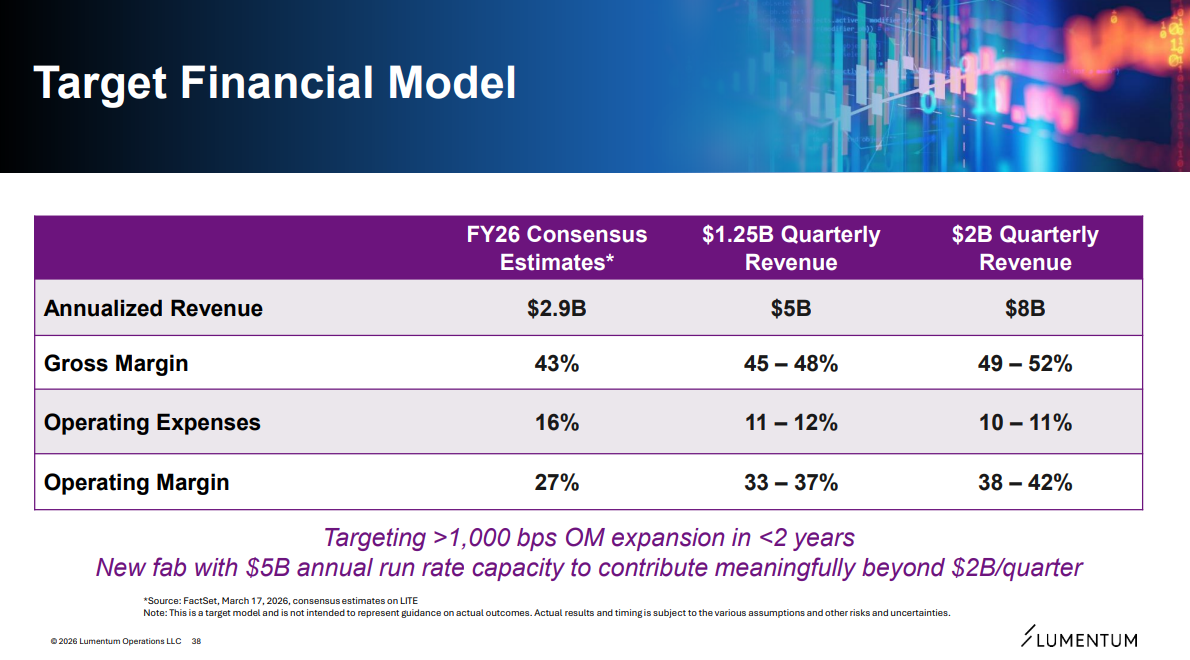
In high-quality companies, these estimates are normally sandbagged.
They also claim that the new fab they acquired is not fully included in these estimates, either partially or entirely, potentially adding another $5B in annual run rate.
Based on their targets, a $1.25B quarterly revenue run rate could be reached in H1 2027, and $2B by H2 2027 or H1 2028, with the new fab coming online in early 2028 and ramping through the year.
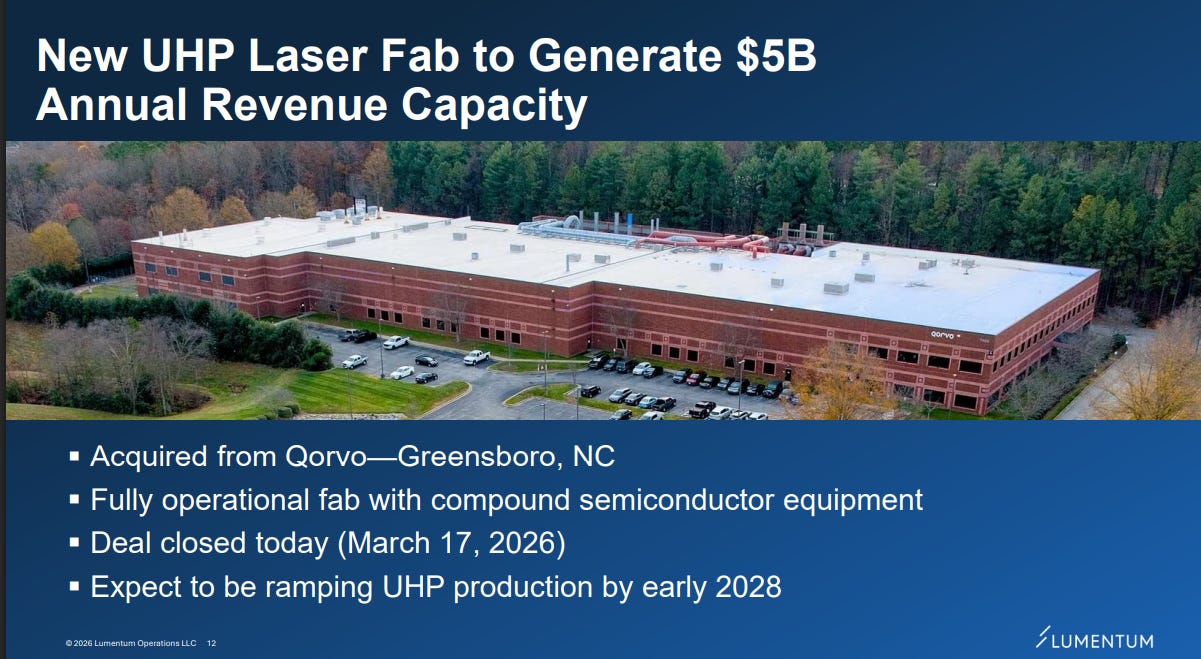
Based on this, roughly $3B in quarterly revenue by Q4 2028, meaning $12B on an annualized basis, looks like the most likely projected figure.
Using the high end of the targets, with a 42% operating margin, that would translate into roughly $5B in operating profit. At a 30x multiple, the resulting market cap would be $150B.
Lumentum’s market cap today is $59B, so on a 2–3 year basis, the upside could be around 150%. I’d label this a bull case, since I’m assuming the new fab sits entirely on top of the other projected revenue.
Mizuho roughly supports this view, although with a more conservative estimate and a $930 price target, estimating $8.8B in revenue in 2028. If they extended that analysis to 2029, they would probably arrive at a figure closer to mine.
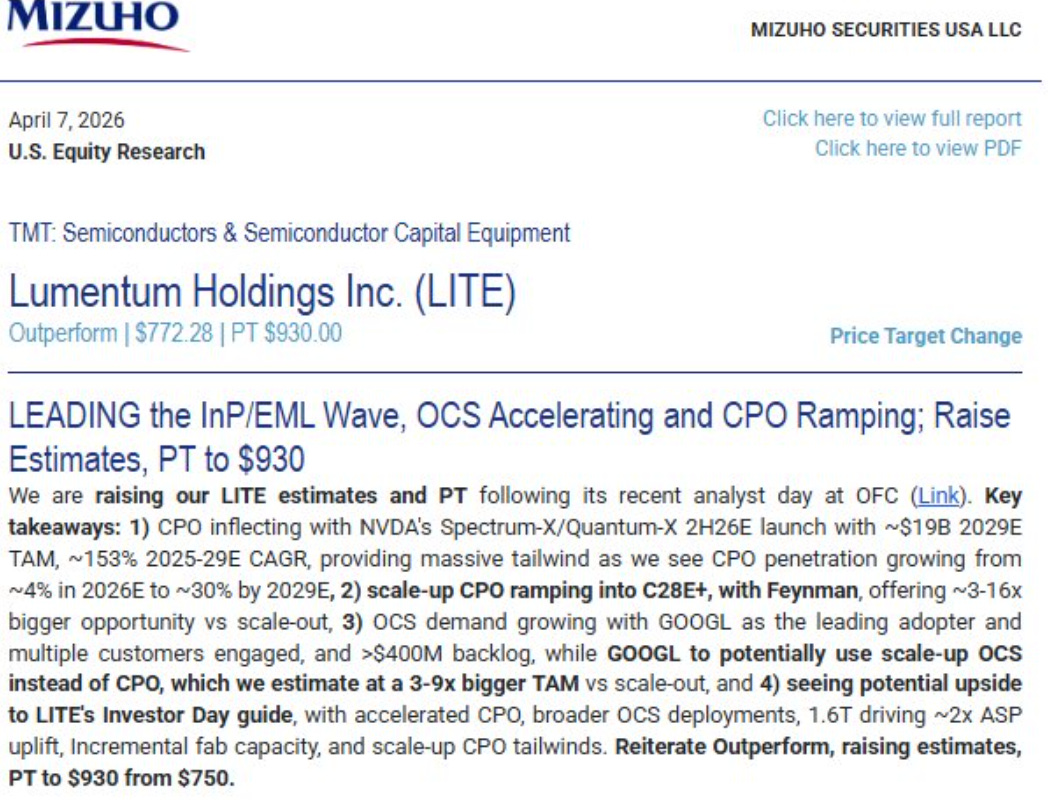
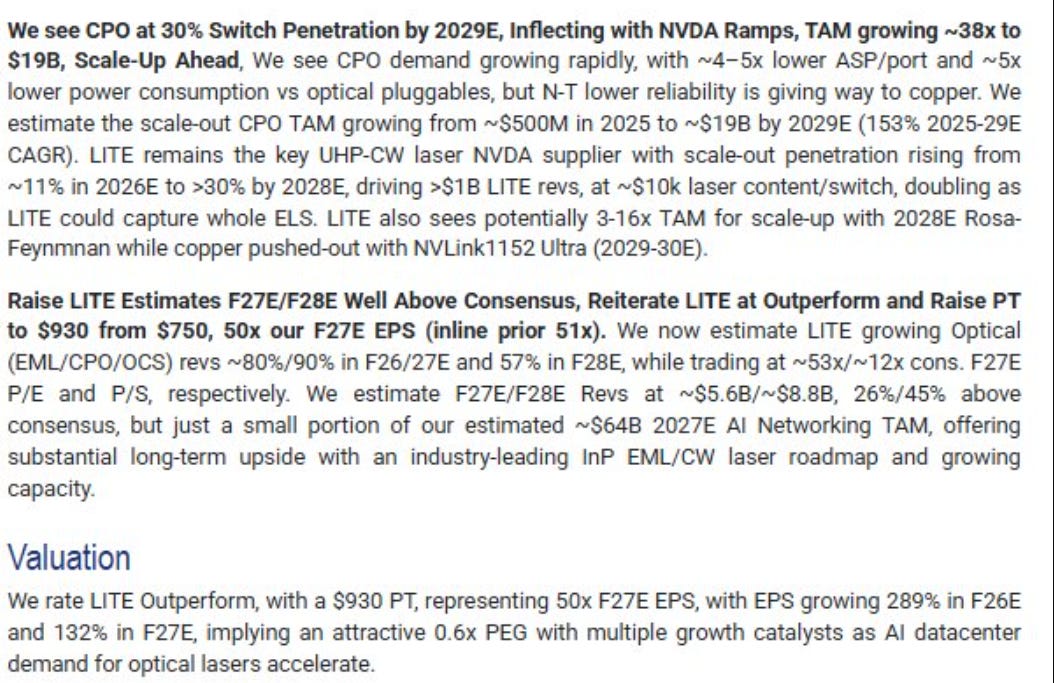
They see a 29% net margin on a 40% operating margin, and apply a 50x multiple to 2027 EPS.
Considering the 132% EPS growth in FY27 and then around 57% in FY28 in their model, the PEG comes out to 0.6, which is quite attractive.
I think the chart looks scary for an entry, even if the fundamentals are great. Any news on delays, engineering problems with CPO at scale, or macro events affecting AI capex will likely hit companies like Lumentum harder than most. Still, it’s a good company to keep on the watchlist, and probably not a bad buy overall with a long-term approach.
Coherent

Coherent will benefit from the CPO boom, but not as much as Lumentum.
The reason is that Coherent’s lasers do not achieve the same performance as Lumentum’s narrow-linewidth lasers, and their EML yields on 6-inch wafers are not as high.
However, Lumentum is also a customer of Coherent, so Coherent should partly benefit from its competitor’s superiority.
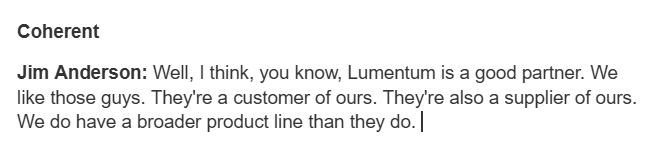
While Coherent is weaker from a technological standpoint, which will obviously result in a lower premium, and probably won’t see the explosive growth of Lumentum, since its offerings will command lower ASPs and therefore worse margins, its valuation clearly reflects that as well.
Coherent trades at 7x NTM sales, compared with Lumentum’s 19x.
Beyond CPO, demand for transceivers in scale-out and scale-across is also extremely high, with Edgewater reporting that optical demand is growing exponentially, while transceiver lead times from Coherent are doubling.
On the optical scale-up side, Coherent is producing high-power CW lasers in volume, ramping 6-inch InP in Sherman, Texas, and has very high-volume multi-year orders from a market-leading AI datacenter customer for CPO solutions.
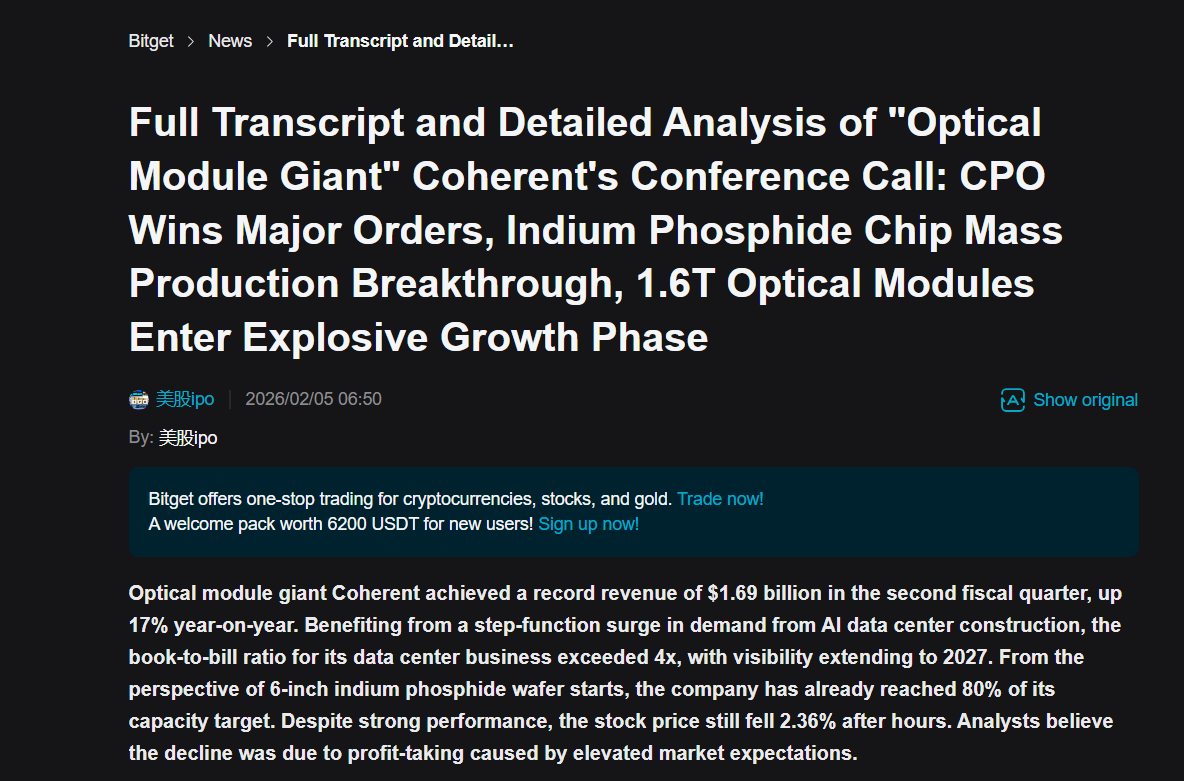
This new CPO revenue is indicated for H2 2026, with capacity doubling through 2027.
I don’t think Coherent at around 40x NTM EPS is necessarily expensive, but I also don’t know whether they will be able to improve their technology enough to benefit from the CPO ramp as much as Lumentum.
I’d say that, from these prices, Coherent likely performs just as well as, if not better than, Lumentum, simply because all the hype and premium are on Lumentum at the moment, and things can change fast in this industry. Coherent is still a very competent company, and even more vertically integrated than Lumentum, which is why it supplies them. It is also well positioned to benefit from scale-up architectures that use CW lasers.
Sivers Semiconductors
As Lumentum is so expensive, many investors have become interested in Sivers. While Lumentum specializes in EML lasers, Sivers specializes in CW lasers, with prototype customers as important as POET and Ayar Labs, two of the most promising photonics startups, especially when it comes to silicon photonics and optical scale-up.
At the same time, POET is a supplier to Celestial, now part of Marvell. So, on a second-order basis, Sivers is also a supplier to Celestial.
The issue with Sivers is that, for the most part, it depends on Celestial through POET, and on Ayar Labs, to gain traction in the industry and succeed. I wouldn’t call that a bad setup, though. Celestial and Ayar Labs are two of the most promising optical scale-up startups.
While I think Sivers can work very well as an extremely high-beta, speculative bet on the space, I also think its financials are terrible.
They have 9 months of runway, and 4 times more debt than cash.
That is the opposite of what you want to see in a ramping startup with little revenue and terrible margins.
As I mentioned in one of my latest posts, I would be interested in entering this stock if they show more commitment to the financial health of the company than to maintaining their ownership percentage, and do a capital raise to clean up their debt, on which they are paying over 10% interest, giving themselves more breathing room and putting themselves in a stronger financial position to hire top talent and become a relevant force in the industry.
3. Advanced wafers and advanced packaging
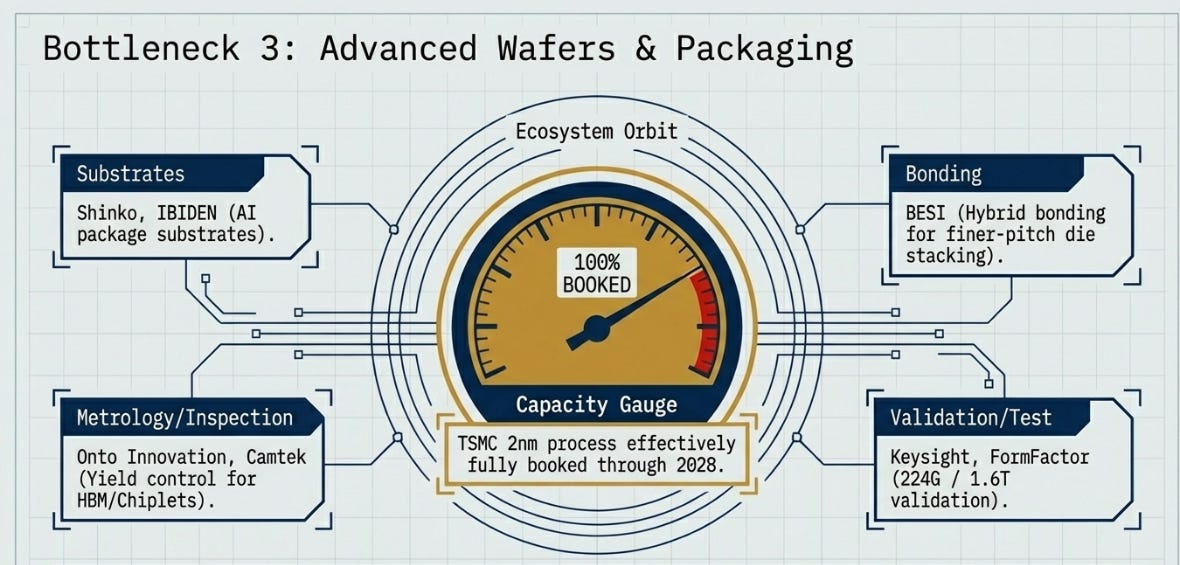
The third bottleneck is advanced wafer capacity, mainly linked to TSMC, and advanced packaging.
The problem is not only whether enough wafers can be fabricated, but whether those chips can then be packaged, integrated, tested, and aligned fast enough using increasingly complex methods such as hybrid bonding and COUPE. Those back-end processes are difficult to ramp, time-consuming to qualify, and much slower to scale than previous technologies.
Broadcom is competing for capacity alongside NVIDIA, AMD, Apple, Qualcomm, Google, Meta, and other ASIC developers, all trying to access the same top-tier manufacturing ecosystem. Even if TSMC keeps building fabs, the surrounding network of substrates, underfill materials, testing, burn-in, fiber alignment, heat management, and other packaging-related components expands much more slowly.
Companies
Capacity
TSMC | TSM | CoWoS, CoWoS-L, SoIC | main platform for AI accelerators with HBM and large multi-die packages
Intel | INTC | EMIB, EMIB-T, Foveros, Foveros Direct | alternative path for large chiplet + HBM packages
Samsung Electronics | 005930.KS | I-Cube, H-Cube, X-Cube | alternative 2.5D / 3D packaging stack, with H-Cube developed with Samsung Electro-Mechanics and Amkor
Substrates / package build
IBIDEN | 4062.T | FC-BGA / AI package substrates | substrate supplier for high-layer-count AI packages, expanding capacity for AI and high-performance servers
Shinko Electric | 6967.T | organic advanced substrates, i-THOP | exposure to future chiplet, optical, and CPO package structures
ASE | ASX / 3711.TW | 2.5D packaging, HBM package assembly | outsourced packaging scale, including HBM package production
Amkor | AMKR | 2.5D TSV, HDFO, advanced package assembly / test | outsourced build and test capacity, tied into Samsung H-Cube
Bonding / inspection / metrology
BESI | BESI.AS | hybrid bonding | direct exposure to finer-pitch die stacking, important for HBM4, chiplets, and future advanced logic
Onto Innovation | ONTO | HBM / packaging metrology and inspection | direct read-through to HBM4 ramp and packaging yield control
Camtek | CAMT | advanced packaging inspection | direct exposure to chiplets, HBM, and hybrid bonding defect inspection
Validation / qualification / test
Keysight | KEYS | advanced package, chiplet, 224G / 1.6T validation | solves the qualification / validation bottleneck as packages and interconnects become harder to debug
FormFactor | FORM | wafer test, photonics / CPO test | relevant as advanced package and silicon photonics test complexity rises
Aehr | AEHR | wafer-level burn-in / reliability | exposure to optical I/O, silicon photonics, and AI interconnect qualification
However, there are more bottlenecks beyond those Broadcom points out, some of which are probably already felt as the new status quo in the industry to such an extent that they no longer even get mentioned.
Foundry shortage
Deutsche Bank analysts reported in January of this year that TSMC’s advanced 3nm process had capacity fully booked through 2027.
On March 23, Taiwan’s Economic Daily News reported that 2nm is fully booked until 2028.
The Chosun Daily on March 30 said TSMC’s 2nm process was fully booked until 2028, and The Korea Herald reaffirmed that TSMC was effectively fully booked for the coming years, with 2nm orders already spoken for through 2028.
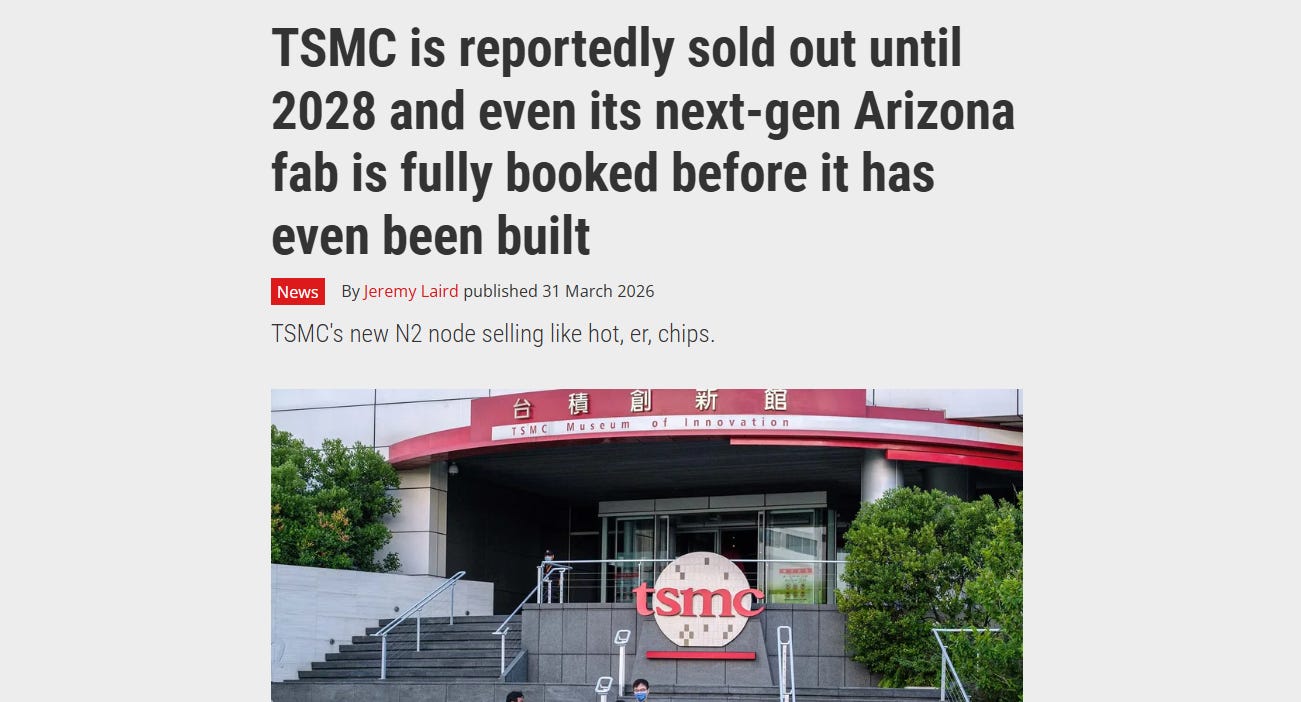
The setup is obvious: there is a massive logic shortage, and everyone is booking capacity aggressively. Once Blackwell, and then Rubin models, come out through 2026 and 2027, what do you think will happen to demand? It will shoot for the stars in an already extremely constrained market. TSMC will not be able to manufacture enough chips, and companies like Samsung, and even Intel, will step in to take a slice of the pie.
The memory bottleneck
Some updates on the memory situation:
Edgewater reported that memory suppliers are pushing much higher LPDDR5X pricing for 2Q, a very sharp quarter-over-quarter increase, at a much faster rate than in PC and server markets. There is a lot of pressure to narrow the gap with compute DRAM pricing, as management viewed pricing as simply too low relative to PC and server DRAM.

According to ETNews, Samsung, after raising DRAM prices by 100% in Q1, is set to increase them by an additional 30% in Q2.
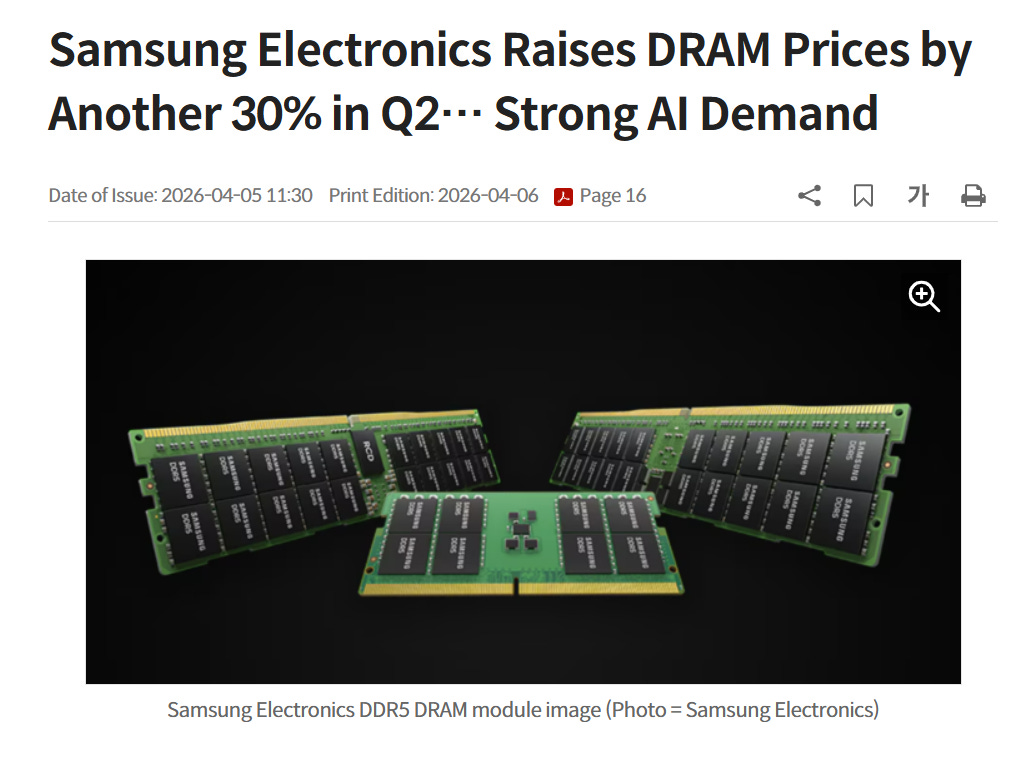
This increase refers to the average price hike across both high-bandwidth memory (HBM) and commodity DRAM, including server, PC, and mobile DRAM.
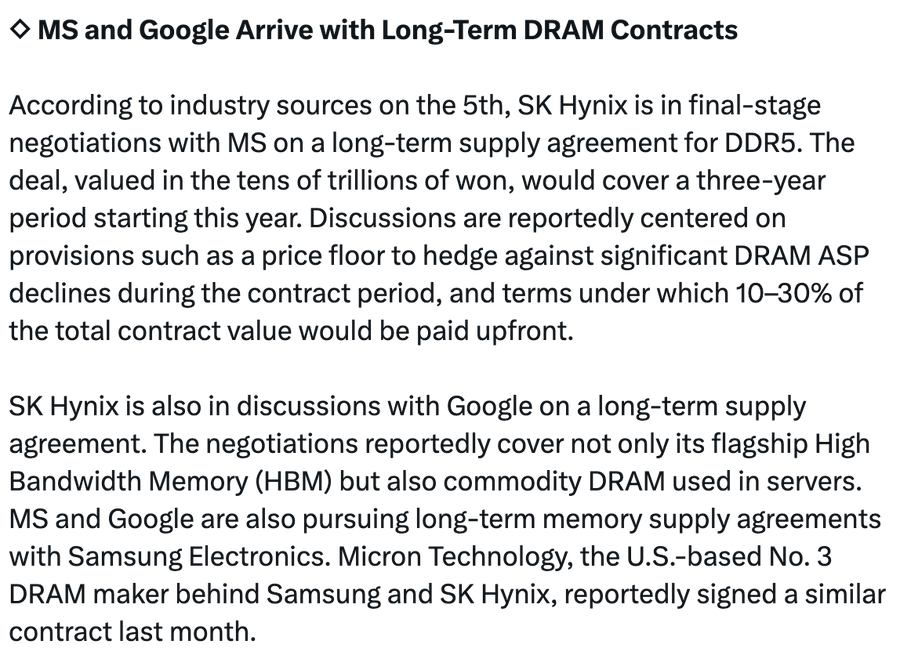
Other sources are also reporting that Microsoft is offering to pay 10–30% upfront on multi-year contracts to secure DRAM capacity.
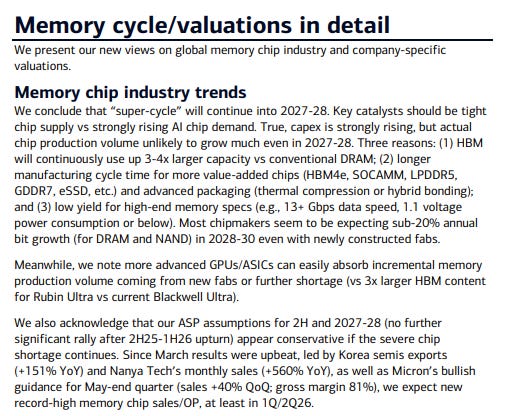
In a report by Bank of America, they concluded that the memory supercycle will continue into 2027/2028. They also said their previous ASP assumptions, which I shared in my latest Micron article, now appear conservative. Those assumptions estimated ASP to peak in mid-2027. It now seems the cycle peak could come later than that.
In today’s report, UBS projects that the DRAM pricing cycle will extend into 2028, with LTAs driving more stable earnings and margins.
As a result, they have raised their price target to $535, from $510.
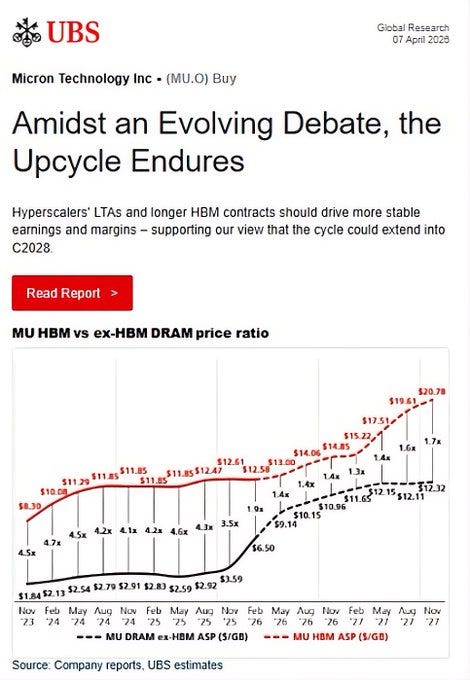
Here’s the summarized valuation model:
We raise our price target from $510 to $535 based on the same SOTP valuation method. We derive around $405 of value for Micron’s core DRAM + NAND ex-HBM business, applying an unchanged ~3x P/S multiple, in line with the 3-year average prior to calendar 2024, when Micron had no HBM contribution, on C27E revenue of $187.7B. Similarly, we derive around $132 of value for Micron’s HBM business by applying an unchanged ~6x P/S multiple on C27E revenue of $27.9B.
While the market cools down on memory names, which is understandable given the strong rally and the macro backdrop, everything points to a severe shortage lasting longer. That is why I believe another 50% rerating in memory names by EOY is likely, given that this would still leave Micron, for example, entering 2027 with an LTM P/E of around 5x.
Energy scarcity
Getting access to power has been one of the major hurdles of the AI buildout, and it is going to get worse.
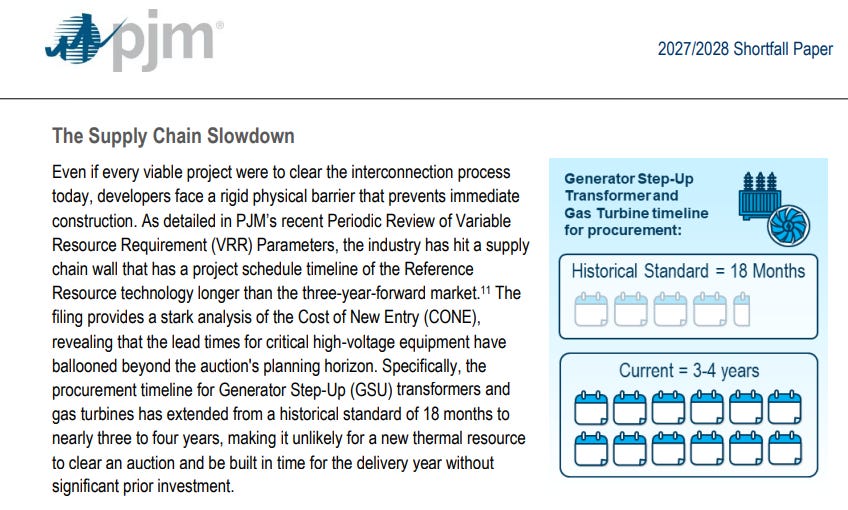
According to the latest PJM report, lead times for transformers and gas turbines have extended from a historical standard of around 18 months to nearly three to four years.
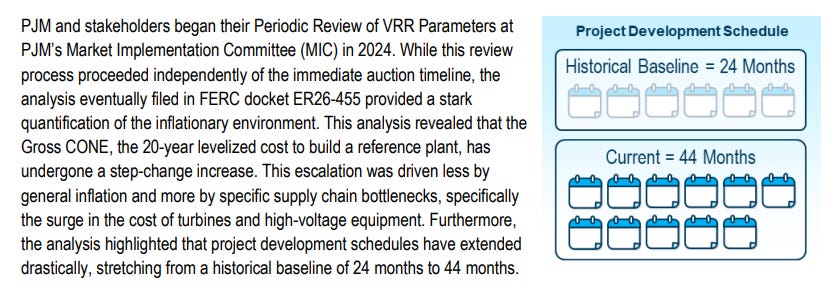
The cost to build a new power plant has increased significantly, and the time required to bring new capacity online has nearly doubled.
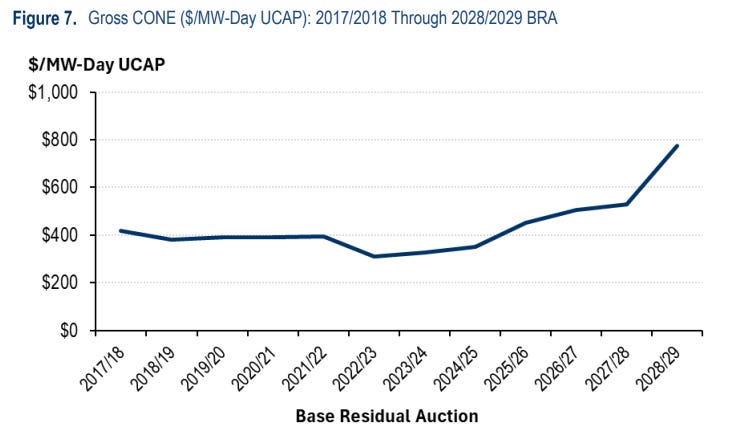
The marginal cost of adding new electricity capacity is rising very fast, which will increase both energy prices and capacity prices.
ERCOT’s queue now has 410 GW of large-load interconnection requests, with around 87% coming from data centers.
Why is it going to get worse?
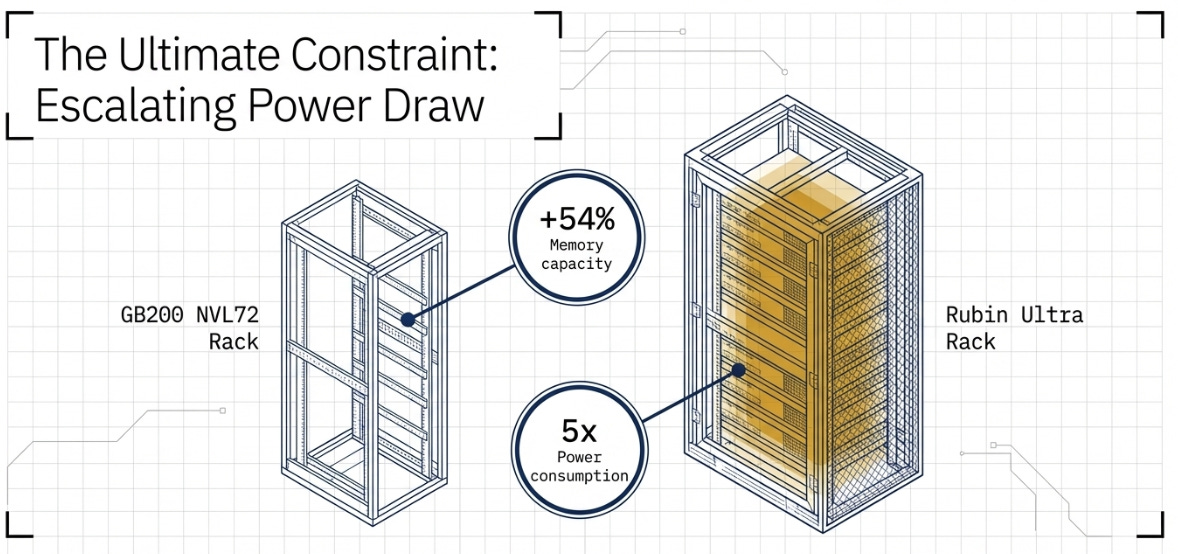
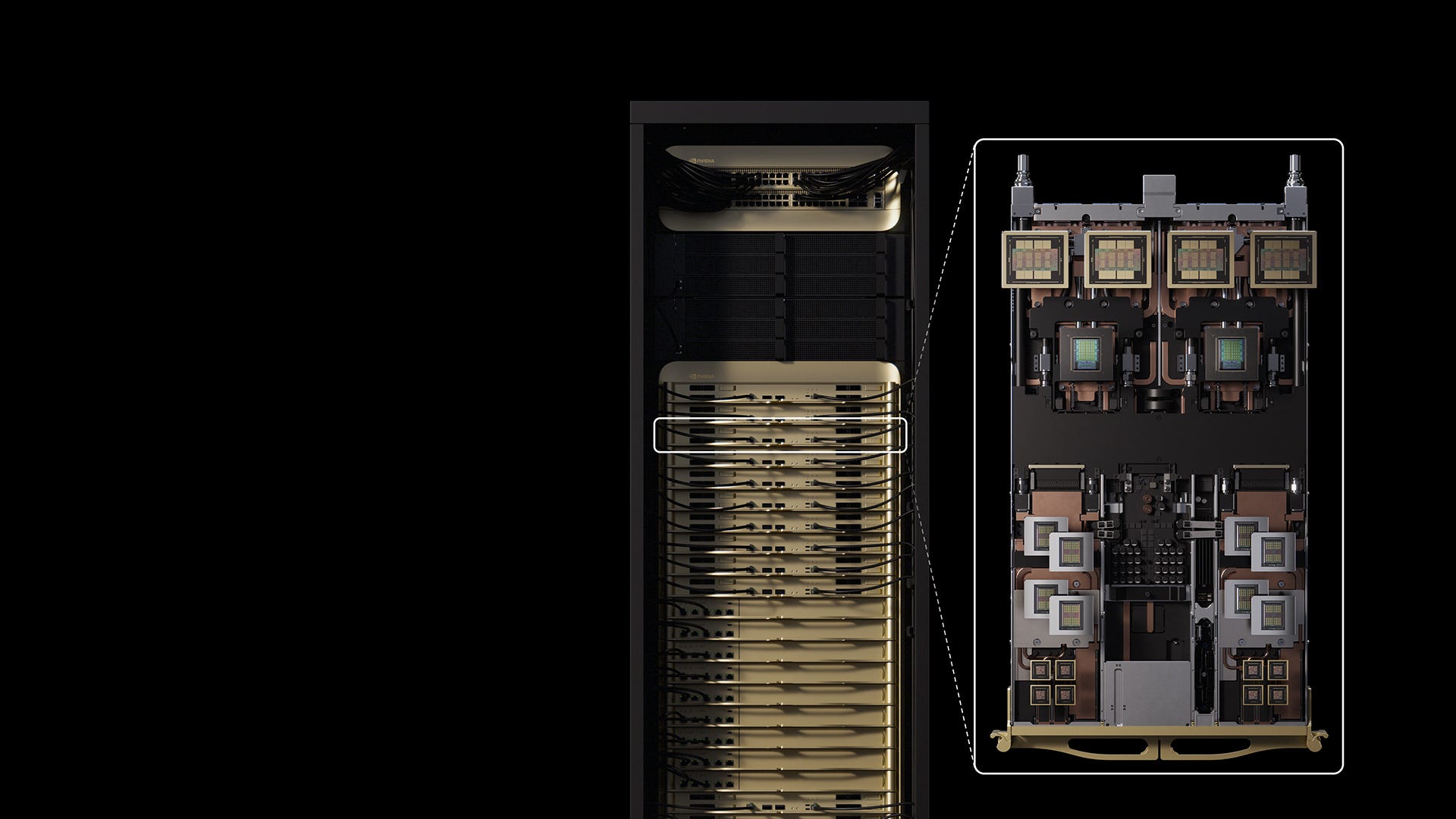
A Rubin Ultra rack will draw 5 times as much power as a GB200 NVL72.
If we compare it with memory, a Rubin Ultra rack has around 54% more memory than a GB200.
So while both memory and energy consumption are increasing, energy is becoming an even more important resource. That is why the long-term bottleneck mentioned by Jensen, Nadella, or Pichai is not memory, but power, because that constraint becomes much worse with each generation.
This shortage is why I’m invested in five names that benefit from it: NBIS, GLXY, CIFR, HUT, and KEEL.
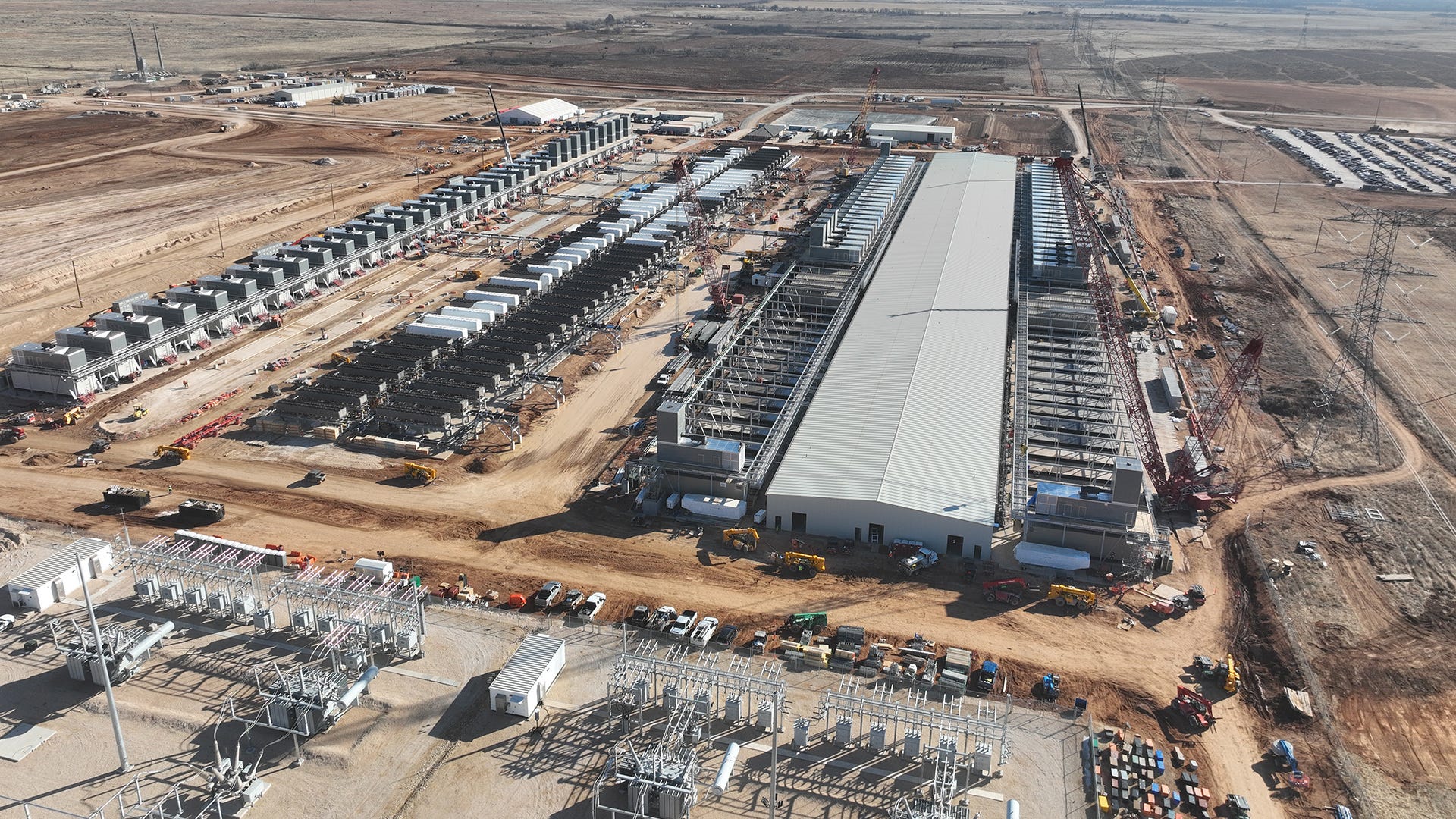
I believe these five will sign multiple additional deals over the next 12 months, and that the sector will see another major rally as the energy crisis becomes a big topic again.
On top of this, Anthropic announced a $30B run rate, up from $19B in February and $9B in December, showing massive growth.
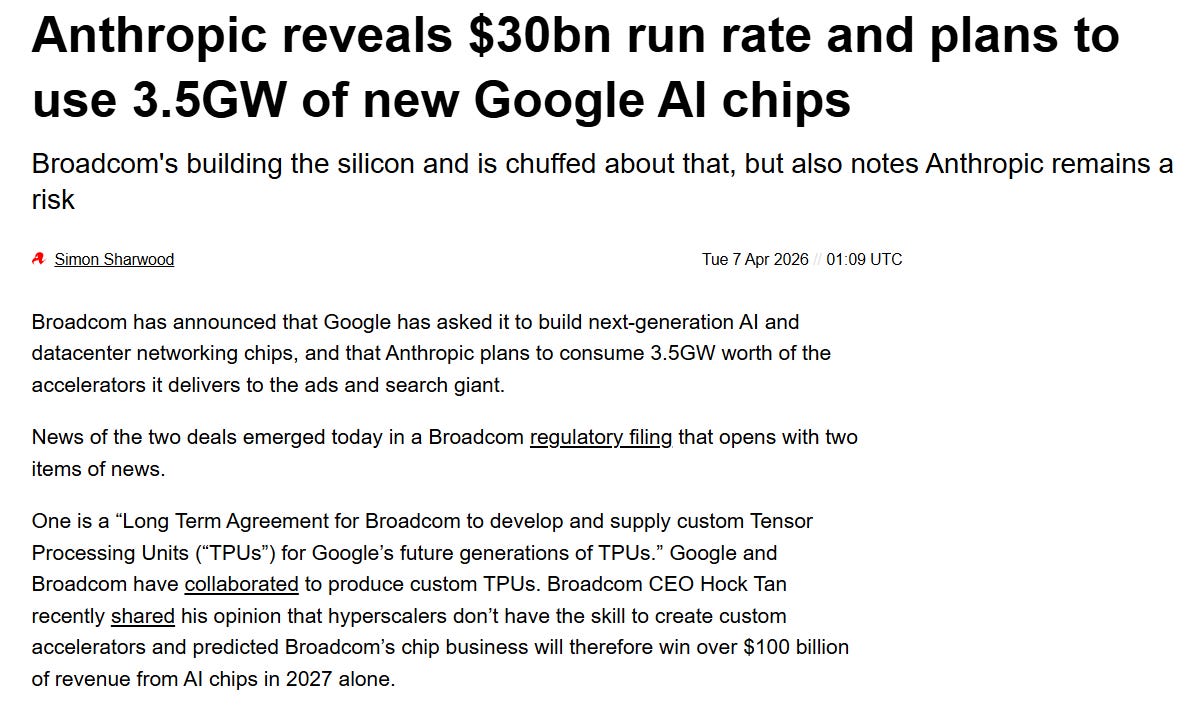
This growth gives them the financial capacity to sign a massive 3.5GW deal with Google to use its TPUs.
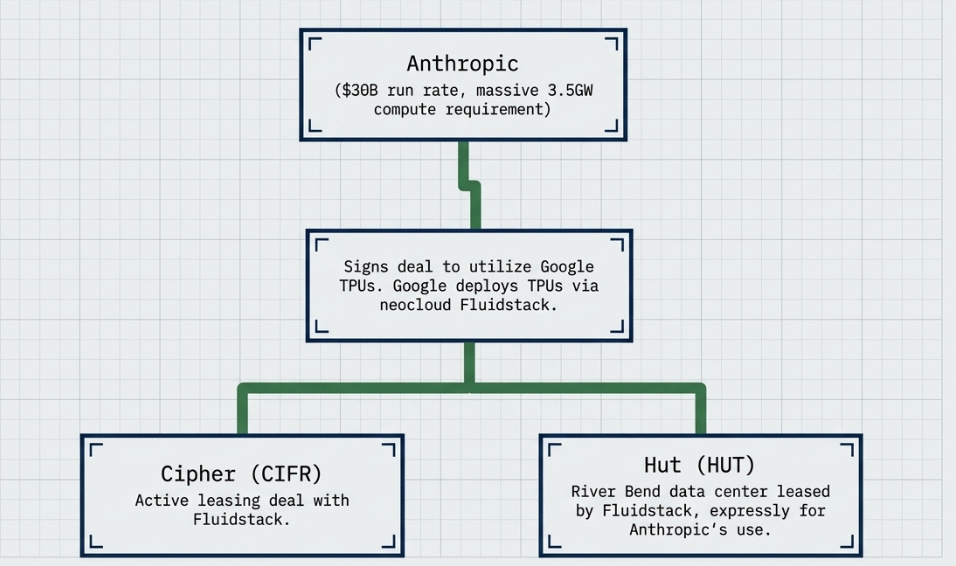
Google deploys many of its TPUs through its backed neocloud, Fluidstack.
Fluidstack has a leasing deal with Cipher.
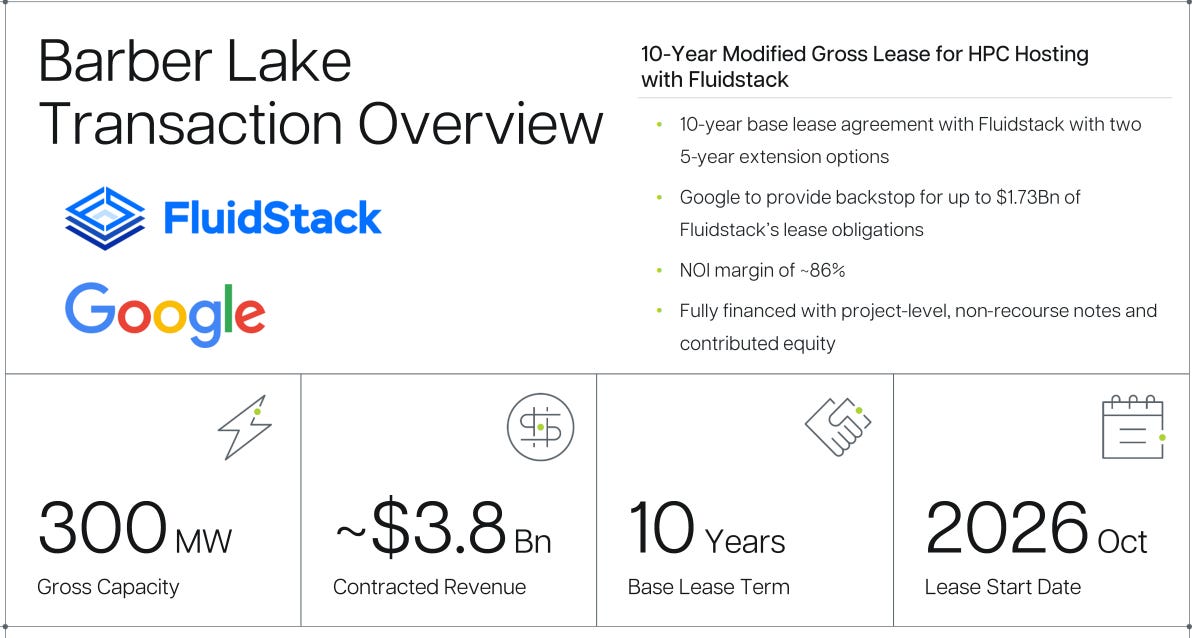
In Hut’s case, the relationship with Anthropic is even clearer, as its River Bend data center, leased by Fluidstack, will be expressly used by Anthropic.

In summary, if Anthropic, through Fluidstack, wants much more compute, Cipher and Hut are likely going to be two of the main beneficiaries.
Samsung
There’s one company that appears across multiple bottlenecks, and that is Samsung.
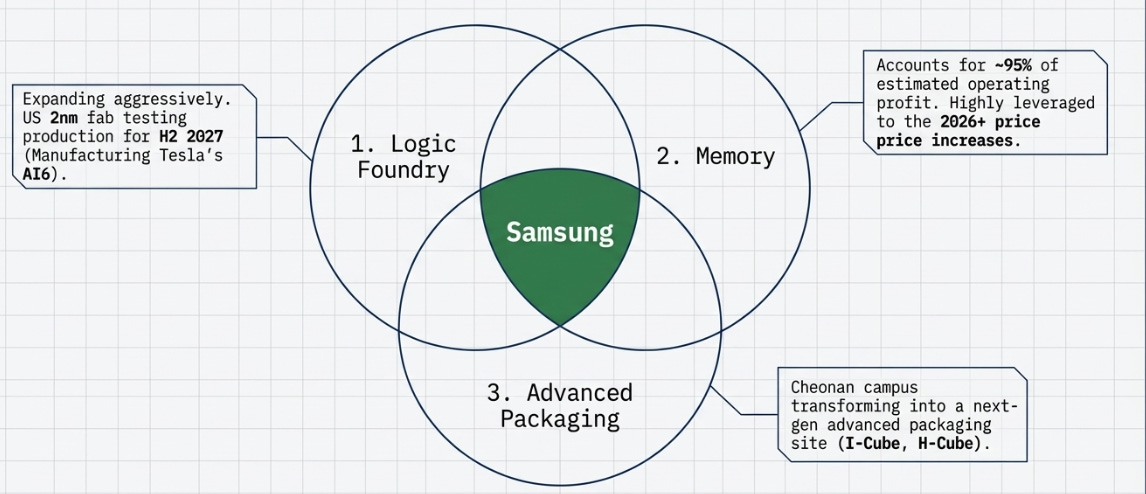
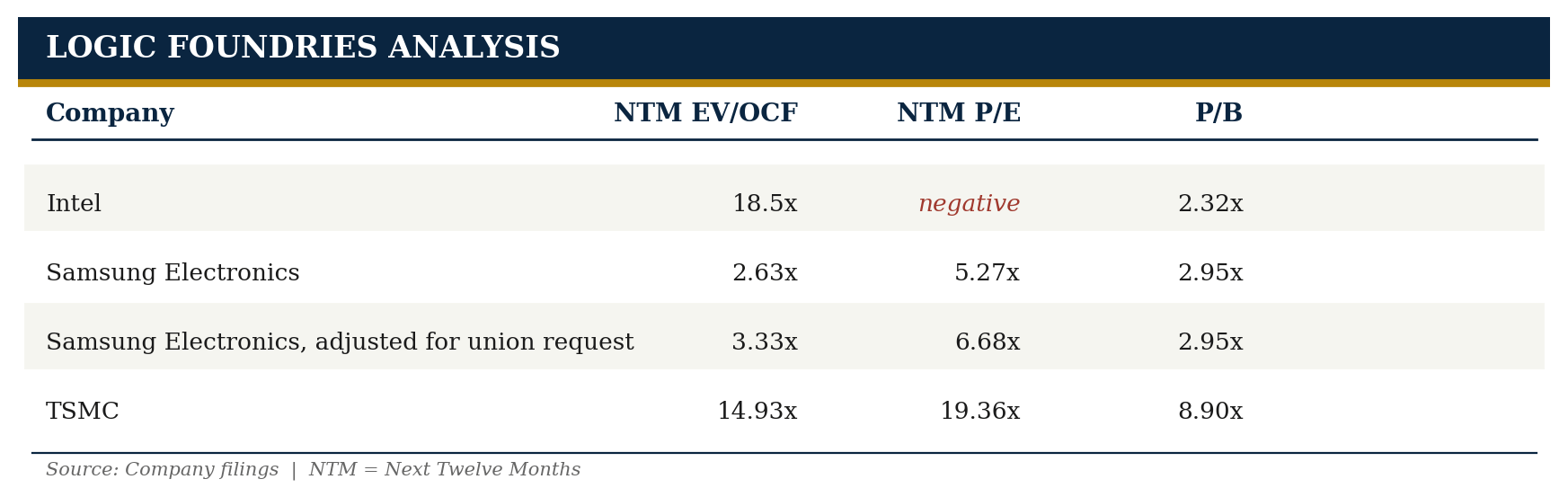
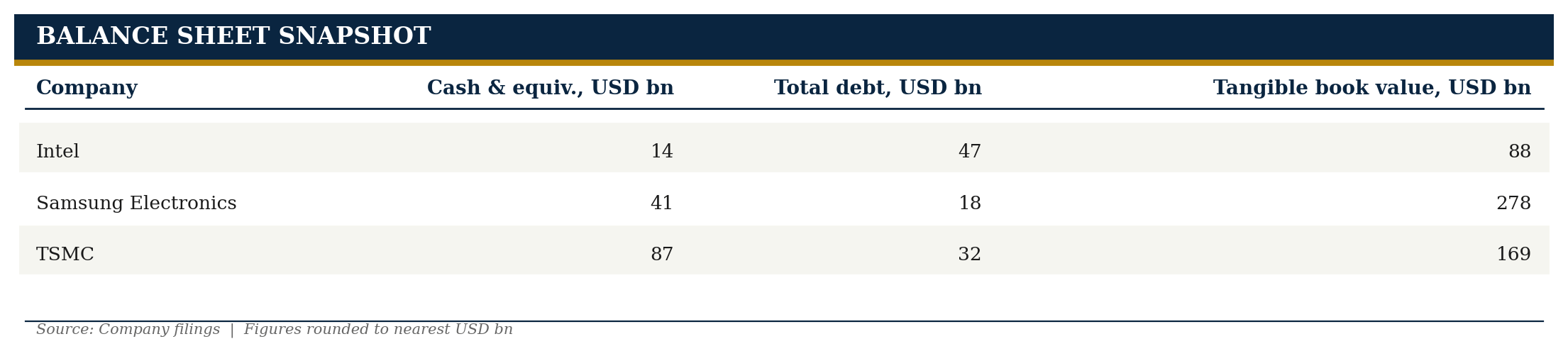
Samsung has a footprint in logic foundry, memory, and advanced packaging, and it is much more profitable than Intel, while also trading much cheaper on a P/E, EV/FCF, and P/B basis than both Intel and TSMC.
Samsung trades very cheaply. That is because memory represents around 40% of sales, and probably close to 80% of operating profit, considering that its Device Solutions segment accounts for 82% of operating profit, while foundry is most likely still not profitable.
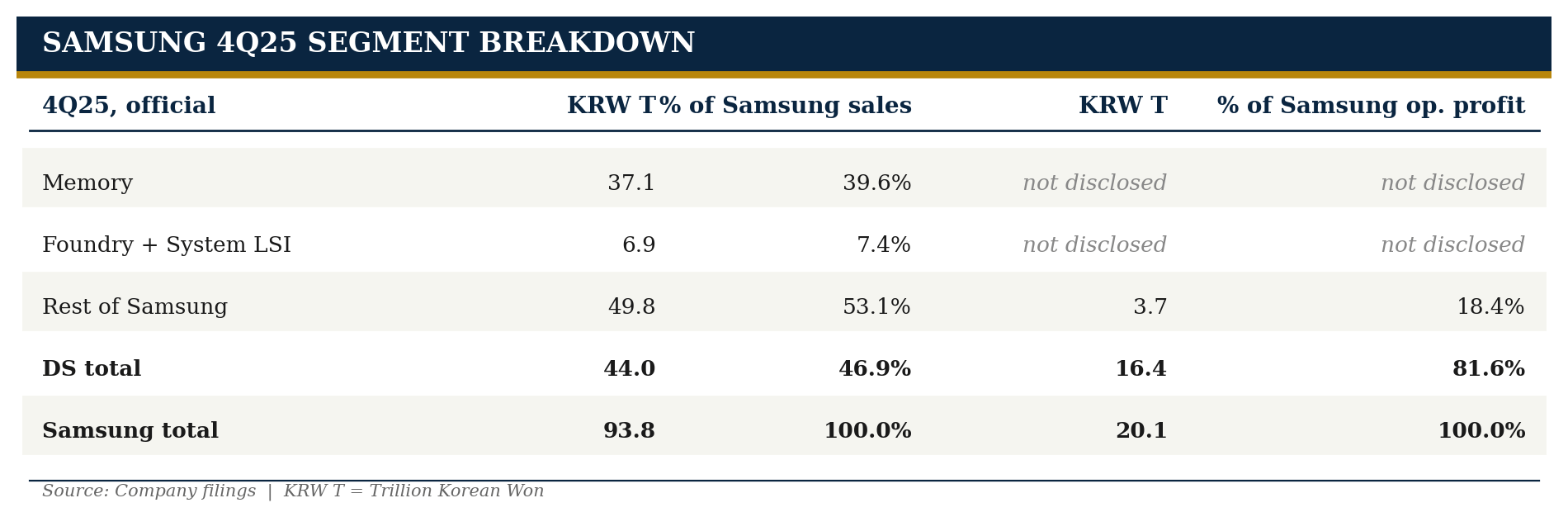
That would make memory even higher than 82% of operating profit, probably closer to 90%, considering analysts estimate that foundry is running at a ₩1.6T operating loss.
When you factor in the increase in memory prices for 2026, combined with weaker performance in smartphones and other retail products, memory will probably account for around 95% of operating profit this year, meaning that practically the whole company will depend on it.
Union Requests
There is also a lot of noise around Samsung. As you can see in the table with the valuation metrics, I included a row showing Samsung’s multiples if it accepted the union request.
This comes as the union is requesting 20% of last year’s operating profit as a bonus, which would match the bonus paid by SK hynix. This union represents 70% of Samsung’s domestic workforce, and it has threatened to halt production. Any stop in production at these memory fabs would take at least one to two months to restart at volume, which would be very damaging.
Samsung is very interesting because, as a large conglomerate, it is exposed to the AI cycle in several ways, and at such a low valuation, even in the middle of the AI hype, it is hard not to be interested.
Samsung Foundry
Samsung is also aggressively expanding its logic foundry business.
US Fabs
Its new 2nm foundry in the US has just started testing production, and targets H2 2027 high-volume production.
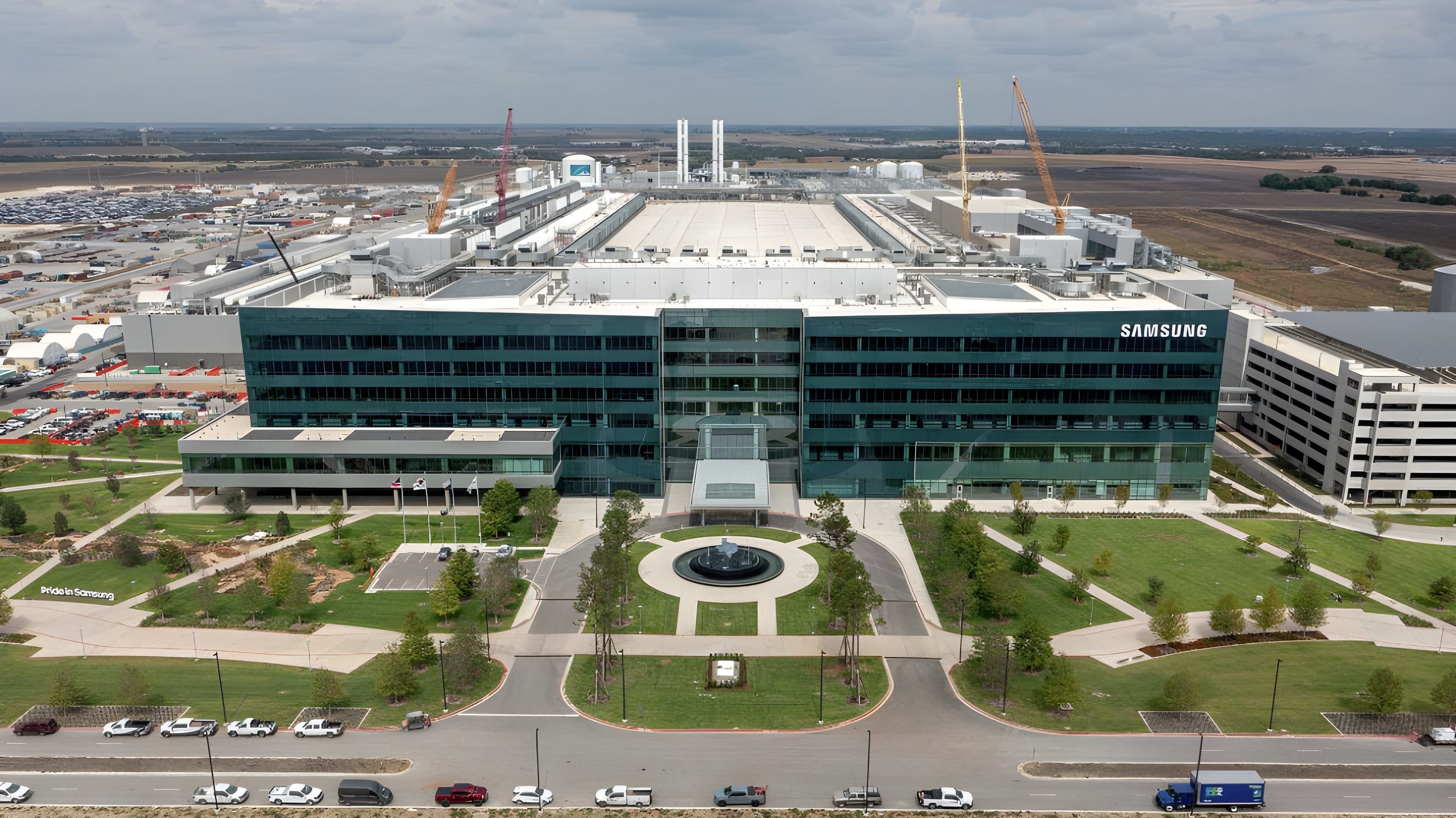
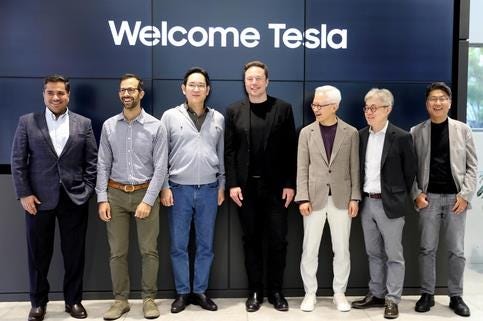
This new 2nm foundry already has an important customer: Tesla, for whom Samsung will manufacture the upcoming AI6 chips.
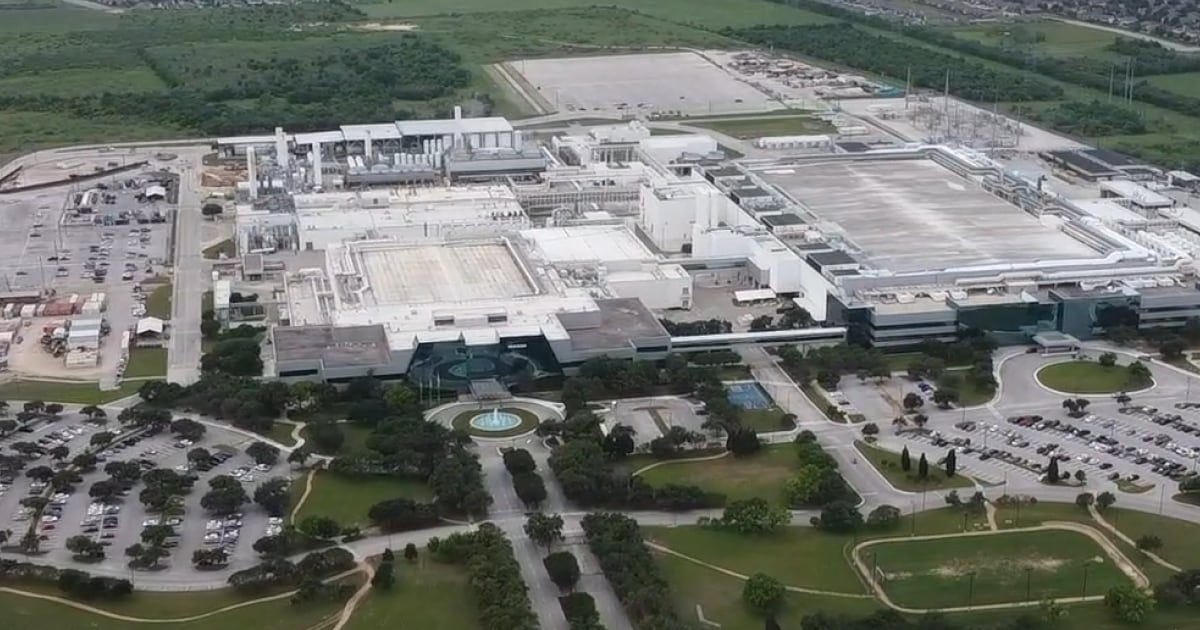
Samsung also has an older fab in Austin, Texas.
Advanced node Korean fabs
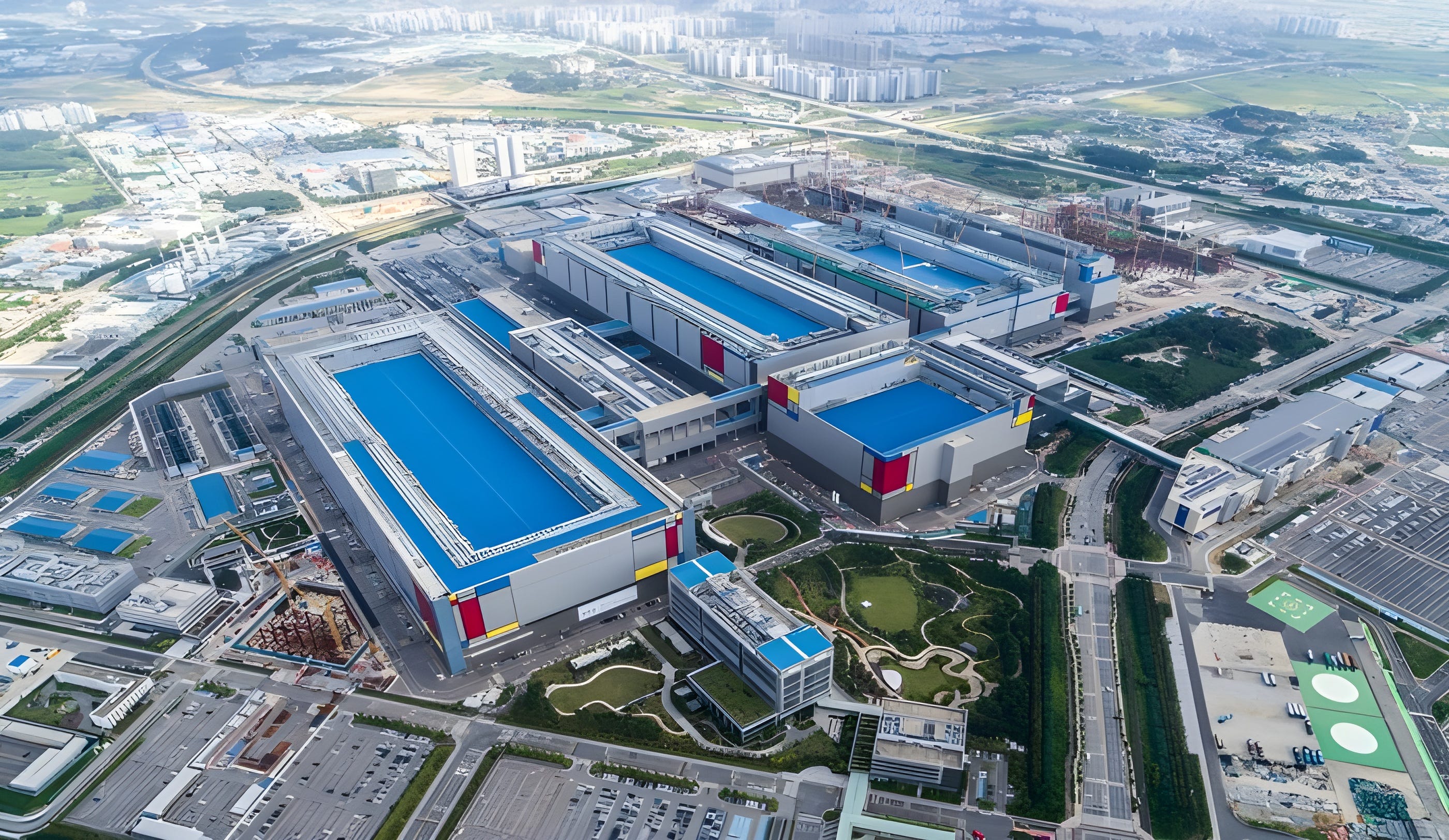
Samsung has two other advanced process fabs in Korea.
At its Hwaseong fabs, it produces nodes ranging from 10nm down to 3nm.
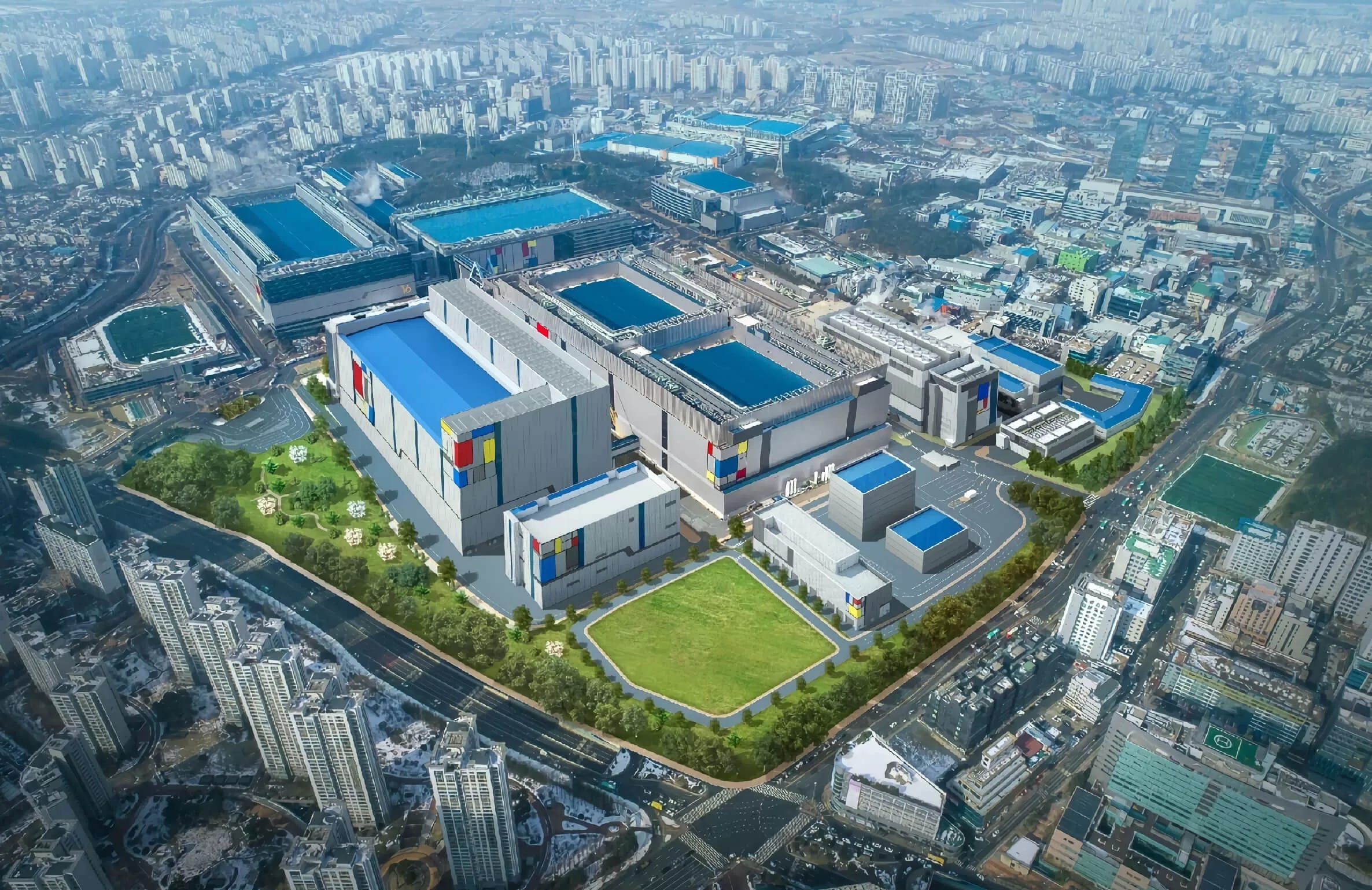
Their other advanced plants are located at the Pyeongtaek campus.
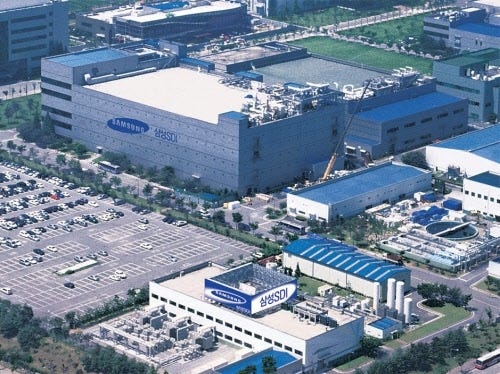
Samsung is also investing to transform its Cheonan campus into a next-generation advanced packaging site.
Rest of Samsung
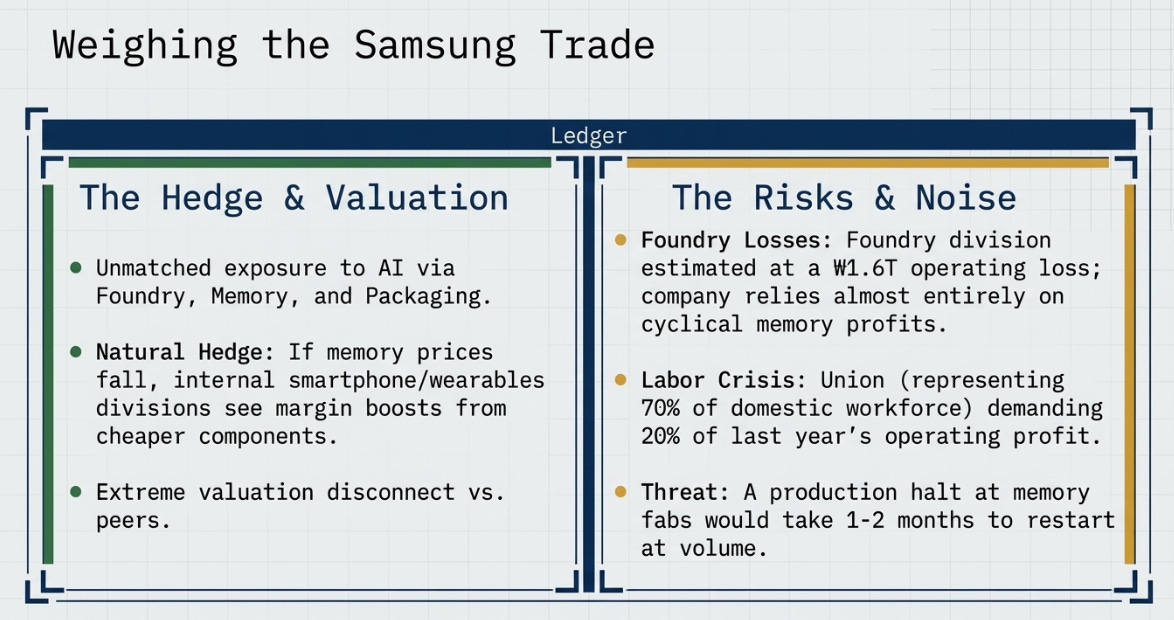
Apart from the semiconductor side of the business, which is by far the most important, I’d argue that Samsung is also partly hedged against the memory cycle because of the rest of its operations.

If memory prices fall, it would still be a net negative for Samsung, but less harmful than for companies like SK hynix and Micron, because its smartphone, wearable, and other consumer businesses would benefit significantly from lower memory costs.
Samsung is also in a great financial position to tackle the next round of growth in the AI cycle.
Conclusion
The summary for the article would be:
Lumentum looks hyped, but it may deserve it. The numbers surprisingly do not look as expensive as the current multiples suggest.
Coherent is the ugly duckling compared to Lumentum, but it will probably deliver returns just as good, if not better, from here.
Samsung looks very undervalued, despite all the macro and union noise.
Adding to any of these three as a base approach could make sense, and I’m thinking about it. Adding on weakness seems obvious.
Advanced PCB, memory, foundry, glass substrates, and energy are the biggest bottlenecks in the industry. Energy will likely become the worst one over time, surpassing memory. Positioning intelligently around these bottlenecks is very advisable, as they will probably not be resolved, at a minimum, until 2028.
Sivers is interesting, more than other speculative names like Aeluma or POET, I’d say. Still, the financial situation is so bad that after this retail pump, if management doesn’t do a capital raise, they’re probably not serious about growing.
Next articles
I always give myself some freedom to decide what to go into next. I’m mostly interested in doing more extended coverage on Samsung, exploring the PCB supply chain in more depth, and continuing to cover the photonics space.
I may also cover some copper and rare earth names. So far, nothing stands out to me as undervalued. The biggest copper pain likely won’t arrive until closer to the end of the decade, and there are many plays in that space, so there is no need to rush. Rare earths is a difficult business, and nothing looks particularly cheap, even after the latest drawdown. I could still write about some of the names I’ve been researching, because it’s an interesting space nonetheless.
I hope you found my article useful.
Until next time,
Daniel
Sivers is also the light source for Jabil 1.6T optical transceivers.
https://www.sivers-semiconductors.com/press/sivers-semiconductors-collaborates-with-jabil-on-energy-efficient-1-6t-pluggable-optical-transceiver-module/
Use of Win Semi to speed up production is a plus, but I agree the debt financing rate was a negative. If they succeed in NYSE listing by spinning off the laser half of the company it might cure their short runway. Not clear to me what will become of my shares when that happens. Please advise if you know how that usually plays out.
The real AI supercycle is happening in energy infrastructure, and most investors are looking in the wrong direction.