

In this article, I’ll explain what’s happening in the markets and what I’m doing.
Let’s go.
Macro Analysis
We’ve had a few choppy weeks in the stock market, especially in semiconductors, which has greatly affected the more leveraged Korean investors.
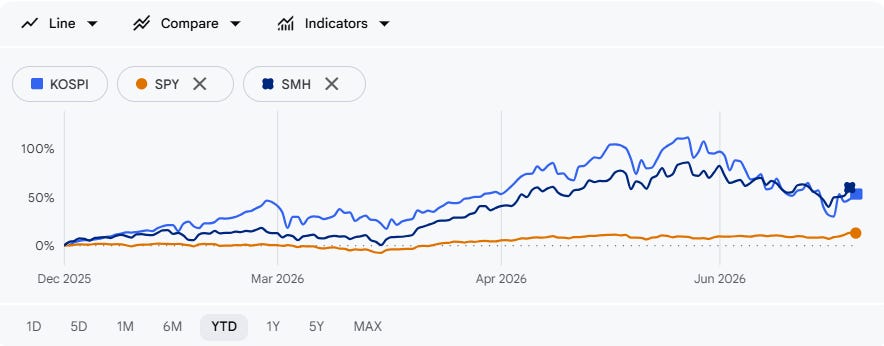
There’s now a clear performance gap.
While the S&P 500 has just reached new all-time highs, the KOSPI and semiconductor stocks remain 25% below their yearly highs.
Why the Rally Became Excessive
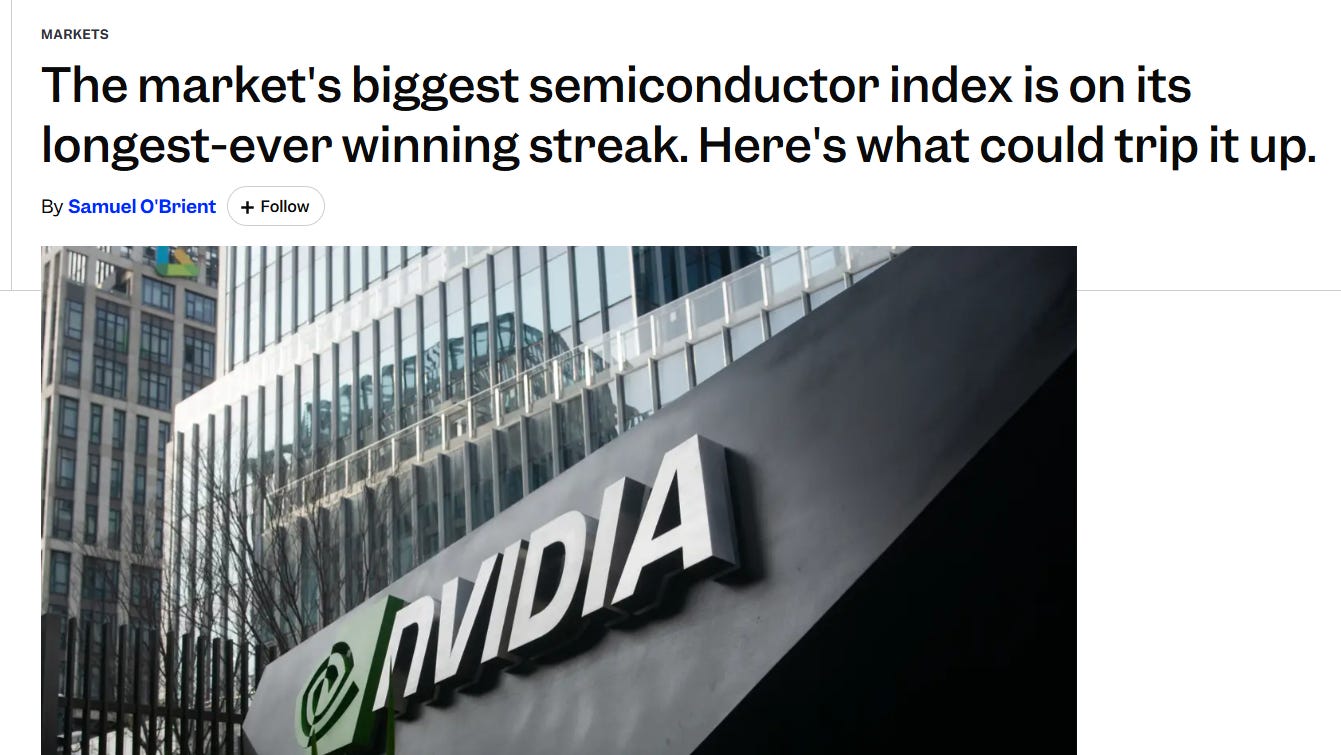
From March through June, we went through the biggest semiconductor rally in history. It seemed as if the market had suddenly started believing in AI more than ever before, almost inexplicably.
I’d say it had a lot to do with the war in Iran.
While we were getting bearish news from the Middle East in the form of higher oil prices, supply-chain disruptions, and broader war fears, the fundamentals of the AI trade were improving in the background. However, they were being suppressed by the bearish market climate.
Once that weight was lifted from the market’s shoulders, all those improved fundamentals were suddenly reflected in stock prices, like a compressed spring being released.
Excesses Started to Build
However, with excitement often comes excess.
Investors started piling into semiconductors as if they were free money. I mentioned this several times throughout my articles and became increasingly selective with my picks.
When I looked at themes such as ABF substrates, MLCCs, optics, and glass cloth, among others, valuations were getting out of hand, pricing in several years of earnings growth.
As if that weren’t enough, the leverage cycle poured gasoline on the fire.
Korean Leverage Reached Record Levels
Korean domestic margin loans reached ₩38.63T on June 24, the highest level ever recorded.
Borrowing specifically against KOSPI stocks reached ₩29.8T, up 71% from ₩17T at the end of 2025.
Margin debt in Samsung and SK Hynix alone reached ₩7.79T, up 208% from year-end. The two stocks represented 28% of all KOSPI margin debt.
The Problem Wasn’t Limited to Korea
However, this wasn’t just a Korean problem.
While Korean investors abused leverage the most, the same trend was also visible in the United States.
U.S. margin debt reached $1.502T at the end of June, up 6.1% in one month and 49% in one year.
Assets held in U.S. leveraged ETFs reached $220B, up 60% from the end of March, with exposure heavily concentrated in technology and semiconductors.
With this level of leverage, any correction can have devastating effects on stock prices.
What Caused the Leverage Unwind?
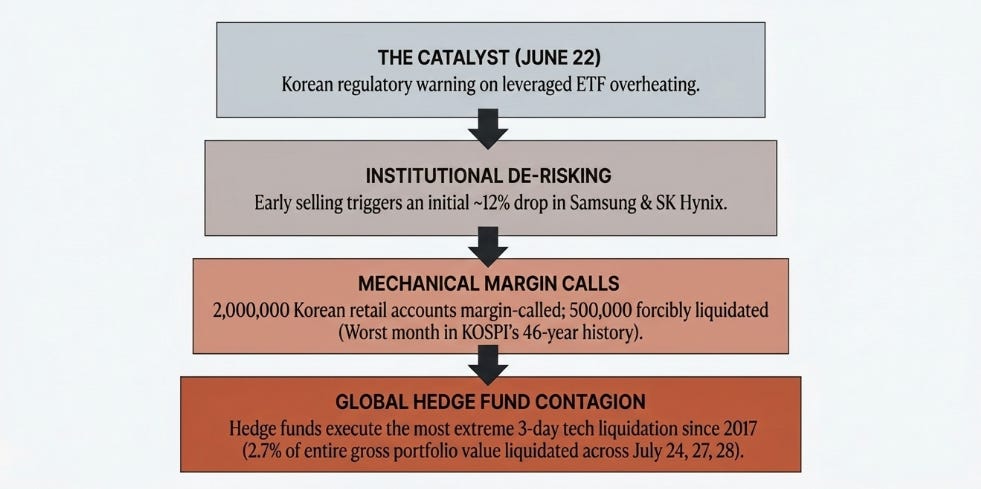
The decisive catalyst was the June 22 regulatory warning.
On June 22, the Korean regulator acknowledged that authorities may have moved too quickly in approving leveraged single-stock ETFs and warned about market overheating.
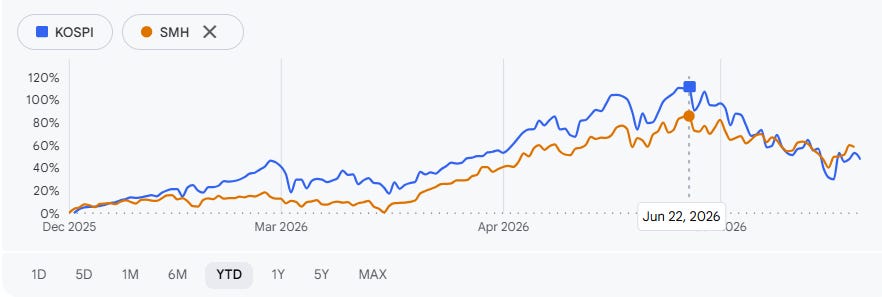
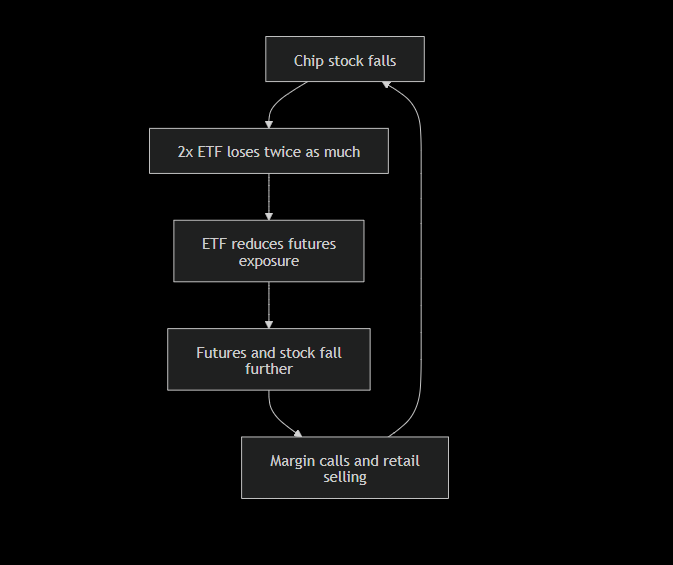
With the risk of leverage restrictions increasing, institutions began selling.
Once Samsung and SK Hynix fell approximately 12%, several mechanical sellers entered the market, creating the domino effect we saw.
Oversupply and Financing Fears Added Pressure
After this, on July 1, Meta was reportedly planning to sell excess capacity as a neocloud, which introduced overbuild concerns into a market that had already seen more aggressive bond issuance to finance AI needs.
On July 7, Goldman data showed that hedge funds had sold U.S. technology hardware for four consecutive weeks amid this combination of historic leverage, oversupply fears, and what some investors saw as excessive debt being used to fund AI capex.
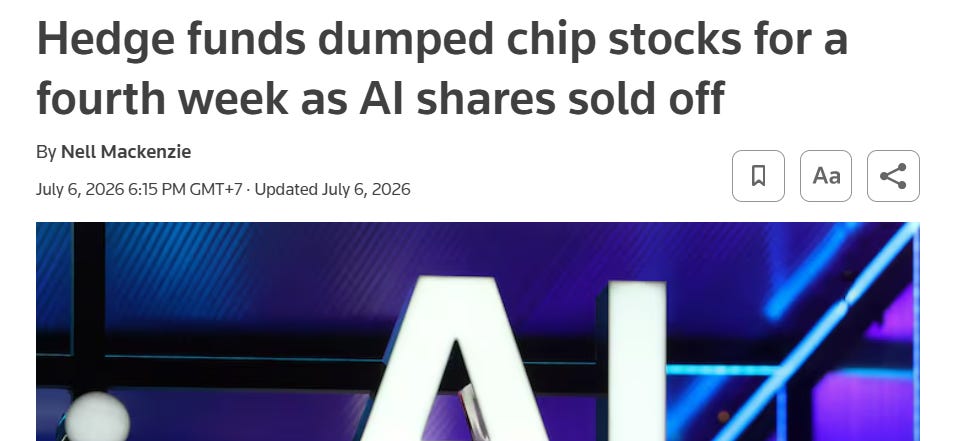
What followed was a historic leverage cleanup.
July became the worst month in the KOSPI’s 46-year history.
Two million Koreans were margin-called, and more than 500,000 were liquidated.
Where Are We Today?
We can look at what some institutions are saying to get a better idea of where we stand today and how the current situation could affect the next phase of the cycle.