

In this piece, I’ll cover Nebius’ Q3 earnings.
1. The Quarter
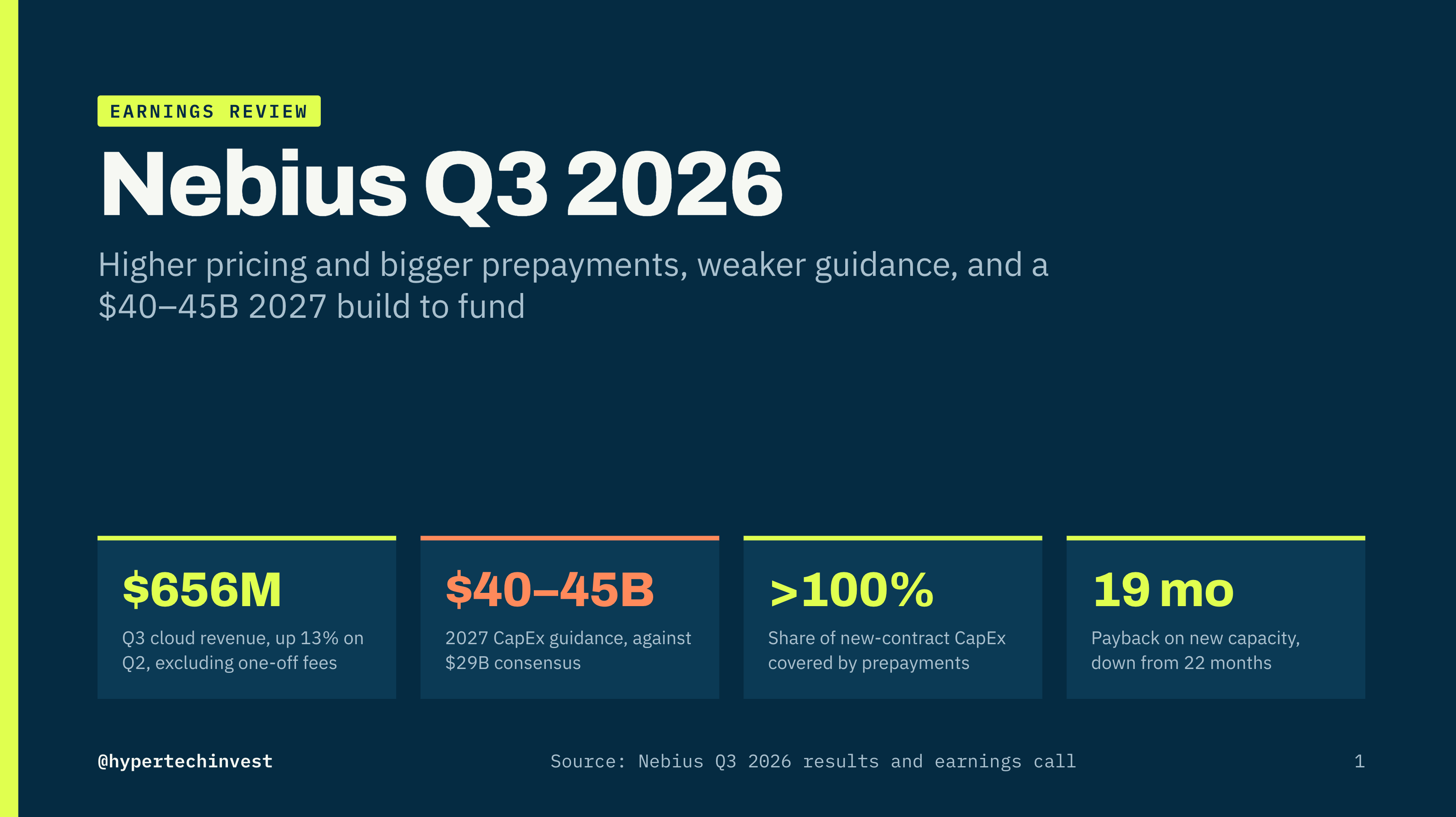
Nebius grew revenue 571% YoY to $981M, beating consensus of $907M. That’s impressive, but at this stage, high growth tells you very little.
Moreover, the headline number needs an adjustment. $325M of Q3 revenue was a one-off: fees Nebius recognizes when it deploys its software and architecture on capacity paid for by a partner, which it calls its asset-light model. Nebius also booked $84M of this partnership revenue earlier in the year.
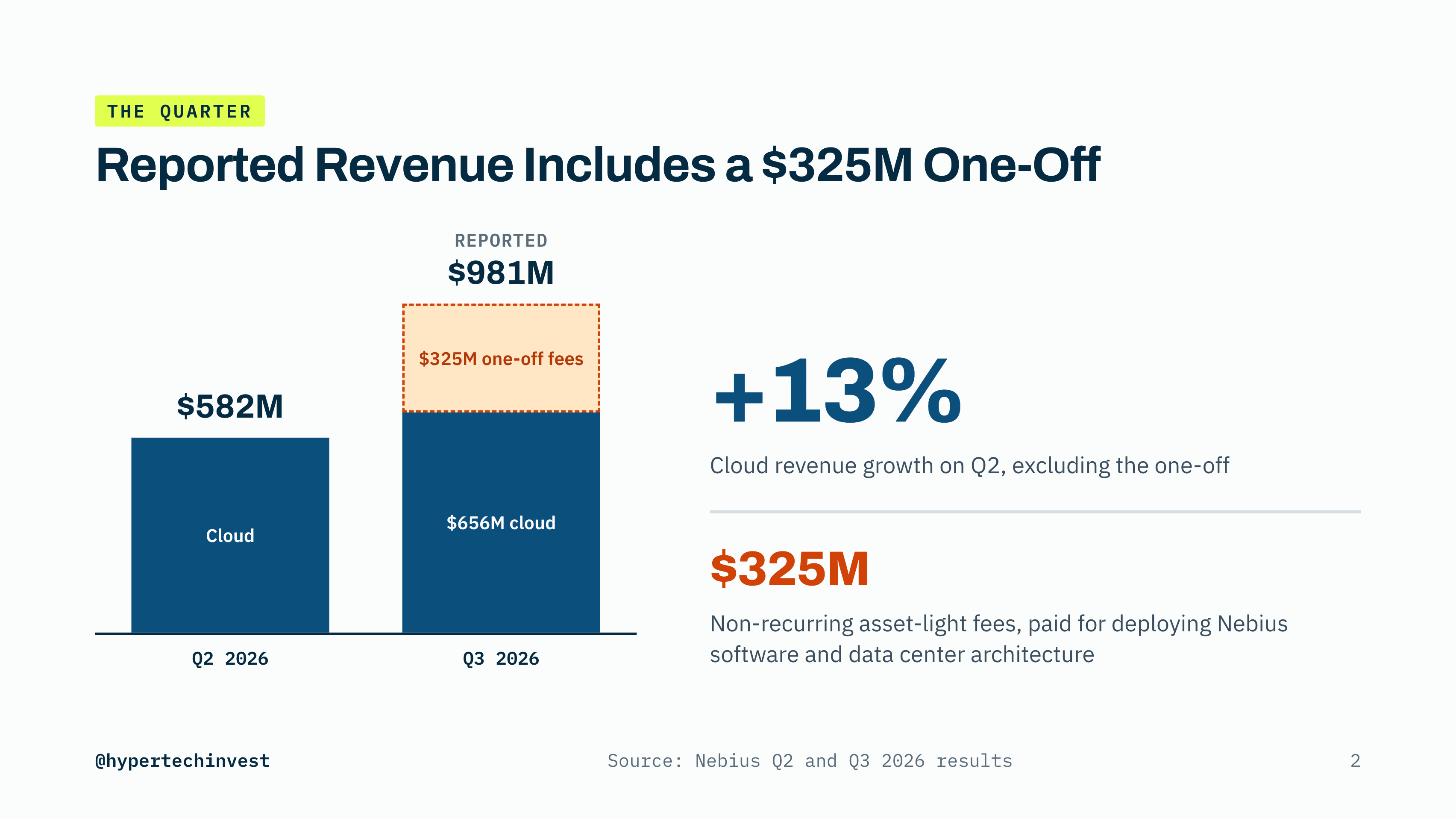
Without those fees Q3 revenue was $656M, roughly $250M below consensus. Operating income swings from +$50M to a loss of up to $275M, and adjusted net income from +$91M to a loss of up to $234M, hypothetically assuming the fees have 100% margin.
So, the whole beat came from one-off fees. If you’re building a valuation model for a neocloud, keep cloud revenue and these fees separate, or you’ll overvalue the business. In fact, management left them out of its 2027 guidance.
2. What’s Actually Moving the Stock
Nebius reported much of the same we’ve seen with CoreWeave, IREN, and even some aspects of the hyperscalers: prepayments, harder financing, huge demand…
But let’s get into what the market actually cares about.
1. 2027 CapEx
The market massively underestimated the CapEx Nebius needed for 2027. I must admit I wasn’t aware of the consensus figure, which was just $29B, completely absurd given that the company has repeated time and time again that it wants to deploy 1 GW of Rubin.
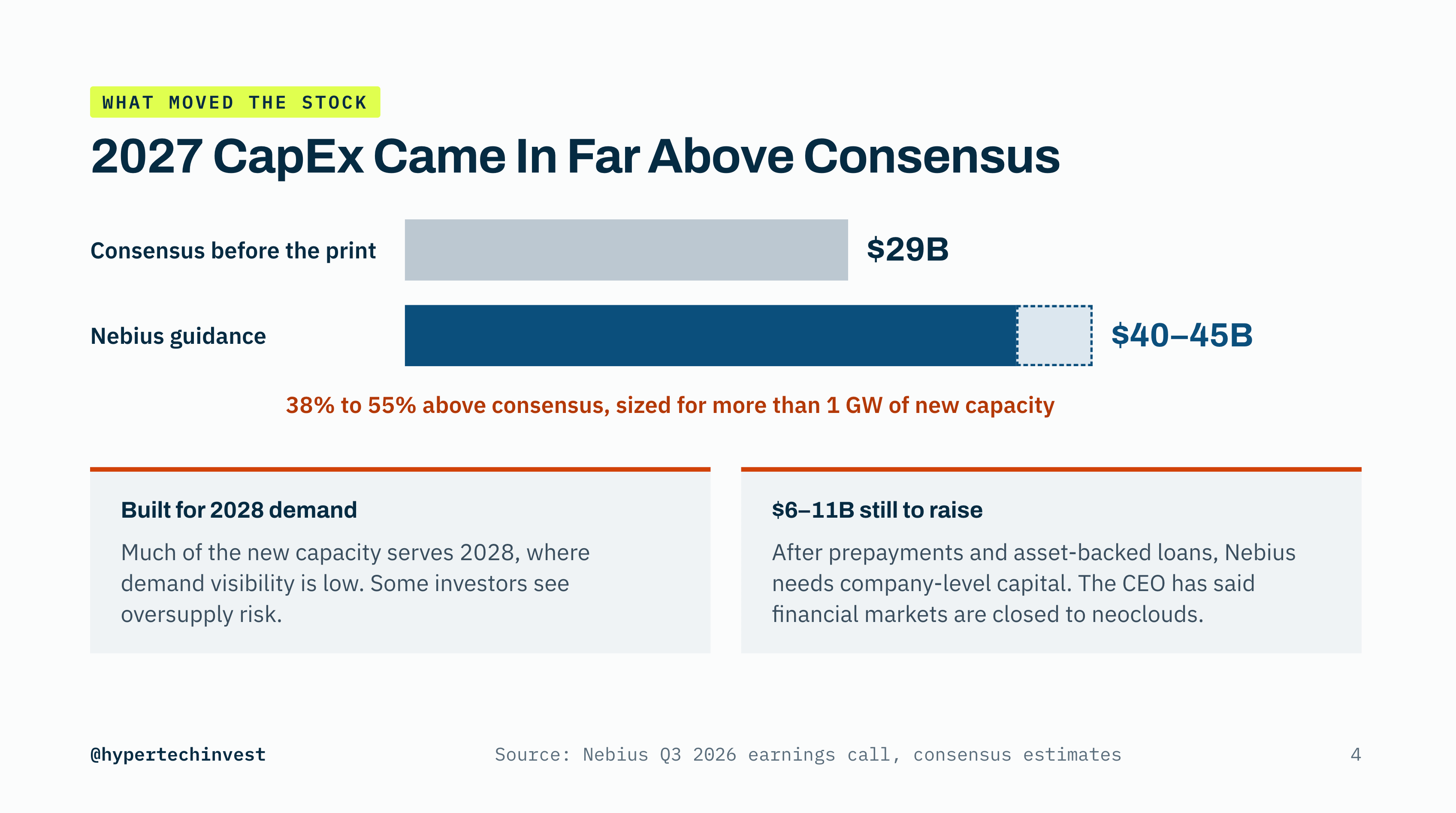
The actual number the company guided is $40–45B, and this creates two problems in the eyes of the market:
Nebius is building a lot of capacity for 2028 demand. The market doesn’t know what to think about 2027, much less 2028. A scenario of oversupply is a possibility from the perspective of many investors.
Maybe even more importantly, after prepayments and asset-backed loans, Nebius would still need to raise $6–11B at the parent company level. Remember, Arkady himself said the financial markets were in a difficult state for neoclouds. The company is partially planning on a macro improvement that may never come.
2. The Q4 Guidance
It’s ridiculous to value a company like Nebius based on what it’s going to do next quarter. In fact, it’s ridiculous to value any company like that unless it signals a more structural financial trend, which it usually doesn’t.
However, that’s not how the market works in the short term, and Nebius missed consensus by a lot.
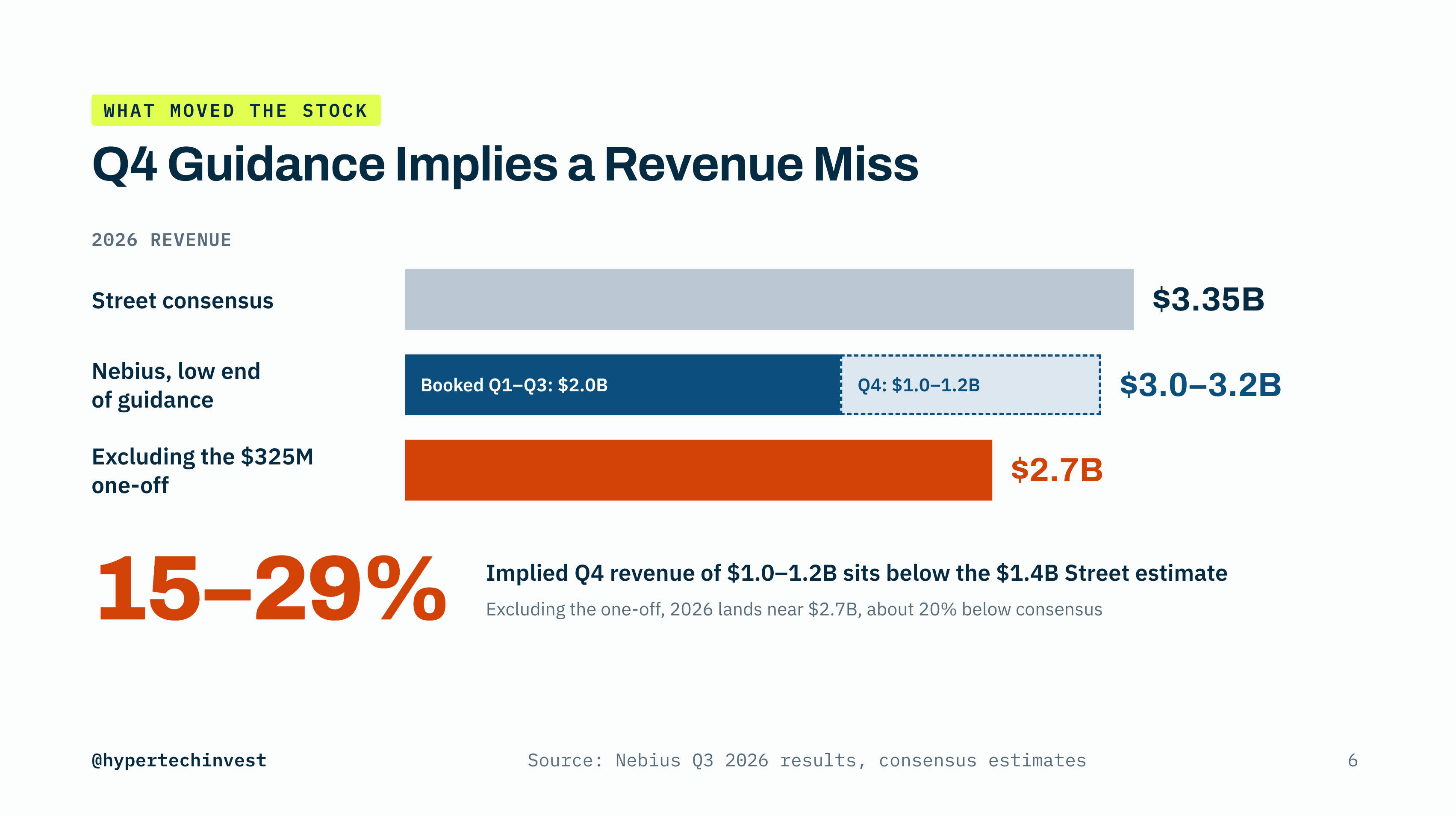
Nebius now expects 2026 revenue at the low end of its range, against $3.35B consensus. With $2B already booked, Q4 implies $1–1.2B. The Street had $1.5B, so that’s 15–29% below consensus. Without the one-off, 2026 lands near $2.7B, about 20% below consensus.
3. The ARR Target Cut
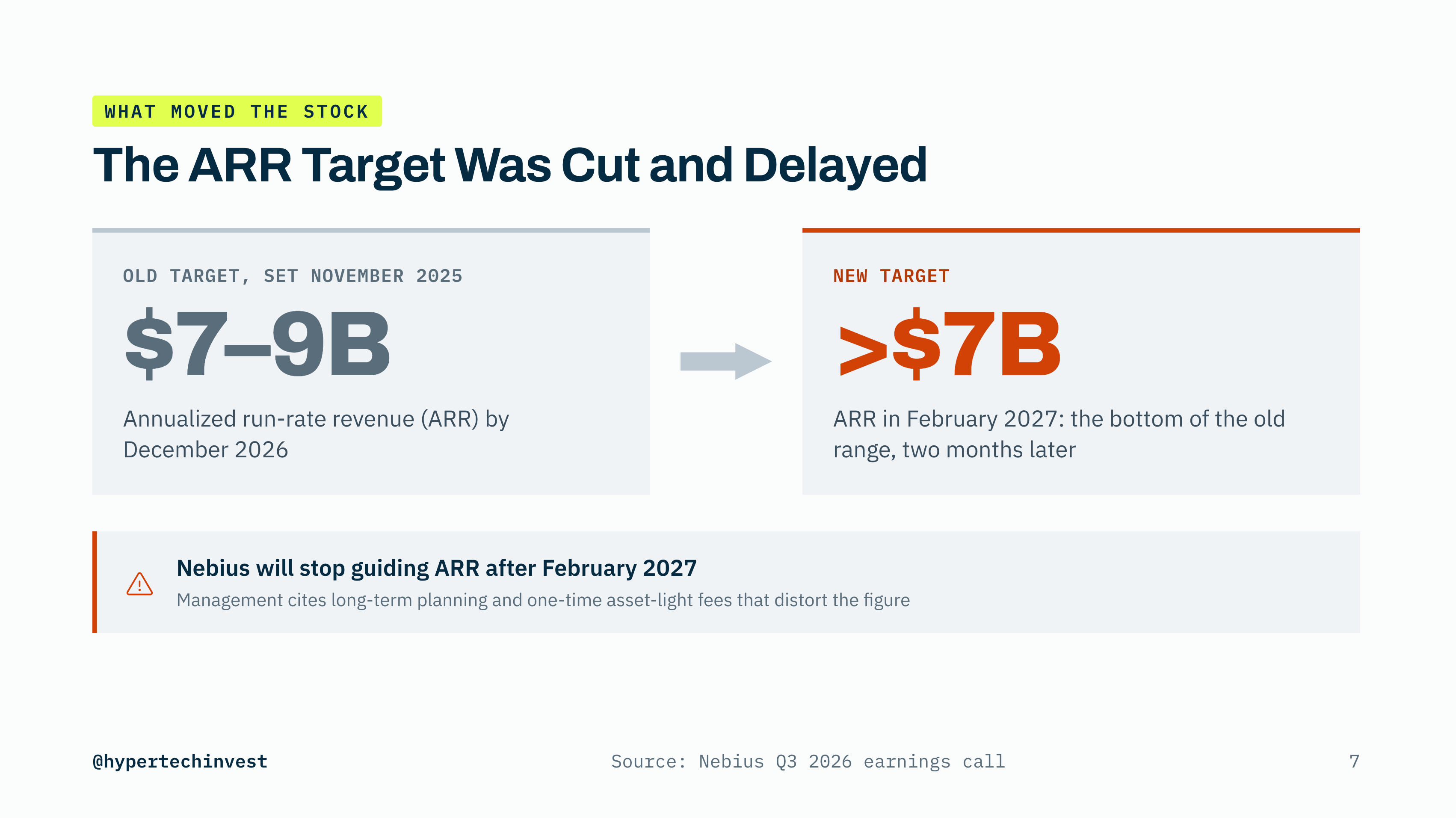
$7–9B by December had been the headline target since November 2025.
The new target is above $7B in February, the bottom of the old range and two months late.
4. The Delays
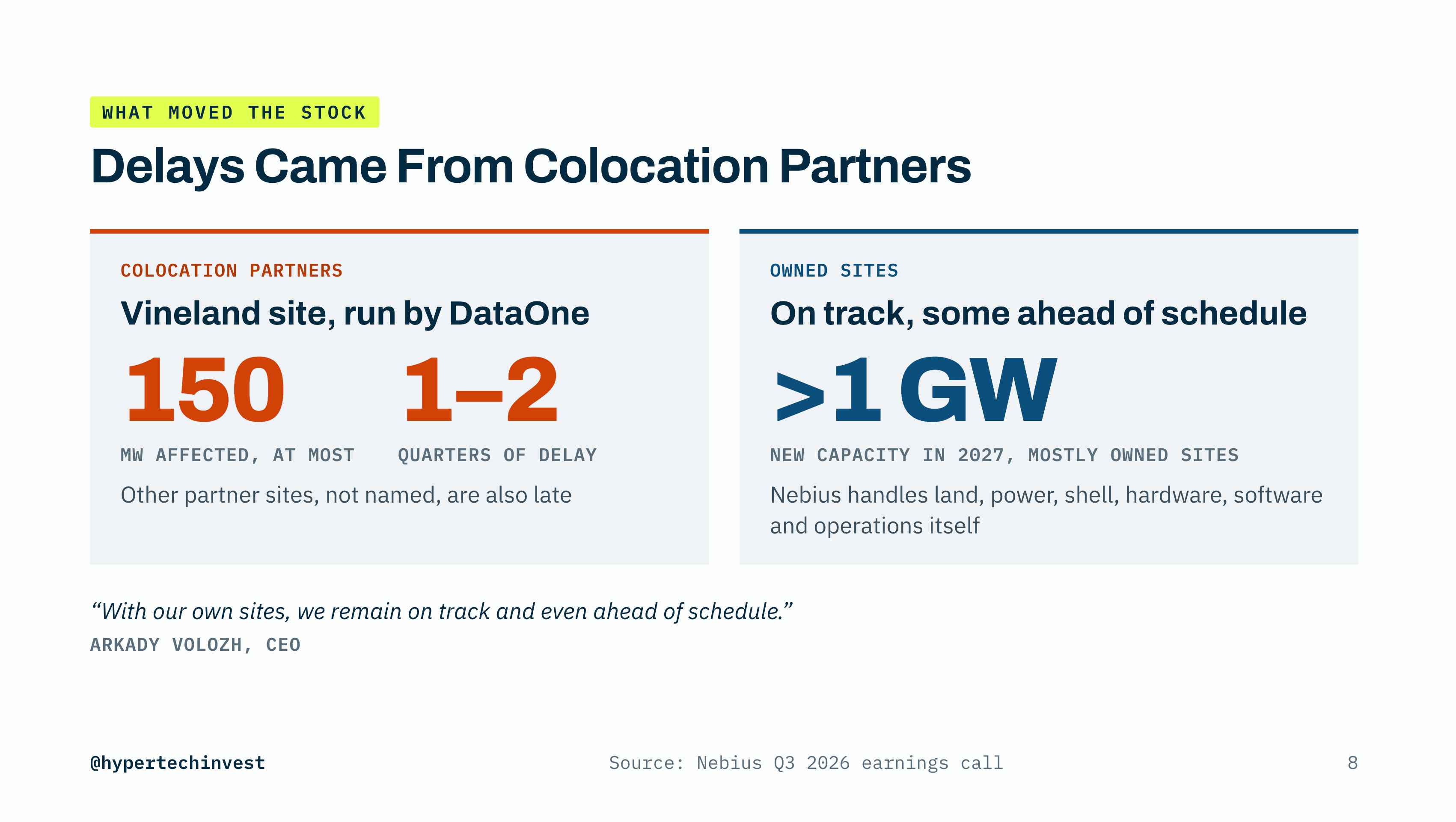
The reason for the weak guidance and the ARR target cut is delays.
The most important one is in Vineland, where there’s a very significant delay of 1–2 quarters on up to about 150 MW.
The reason? Incompetence by DataOne, their colocation provider.
Other unnamed sites are also delayed, and Nebius has signaled that it wants to go vertical and stop relying on partners that, in many cases, aren’t up to the task:
“With our own sites, we remain on track and even ahead of schedule.
That’s important because going forward, most of the next gigawatt we’re bringing online will be on our own sites, where our own team does everything, land, power, shell, hardware, software, and operations.
This gives us confidence for next year.”
— Arkady Volozh, Nebius CEO
The Financing Question
2026 CapEx financing is locked in, the question is next year.
On financing for 2027, the CFO said:
“We expect CapEx of $40 billion-$45 billion, sized for more than a gigawatt of new capacity, a majority of which will become online from owned sites that hold a stronger margin profile than colocation capacity.
To fund this ramp, I want to highlight that we expect that 75%-85% of our CapEx range will be funded by prepayments and asset-backed financing of our current investment-grade contracts.
We expect that in 2027, customer prepayments will account for $17 billion-$20 billion.
We also have a very healthy balance sheet, giving us the flexibility to be opportunistic with external capital when it is cost-effective to do so.”
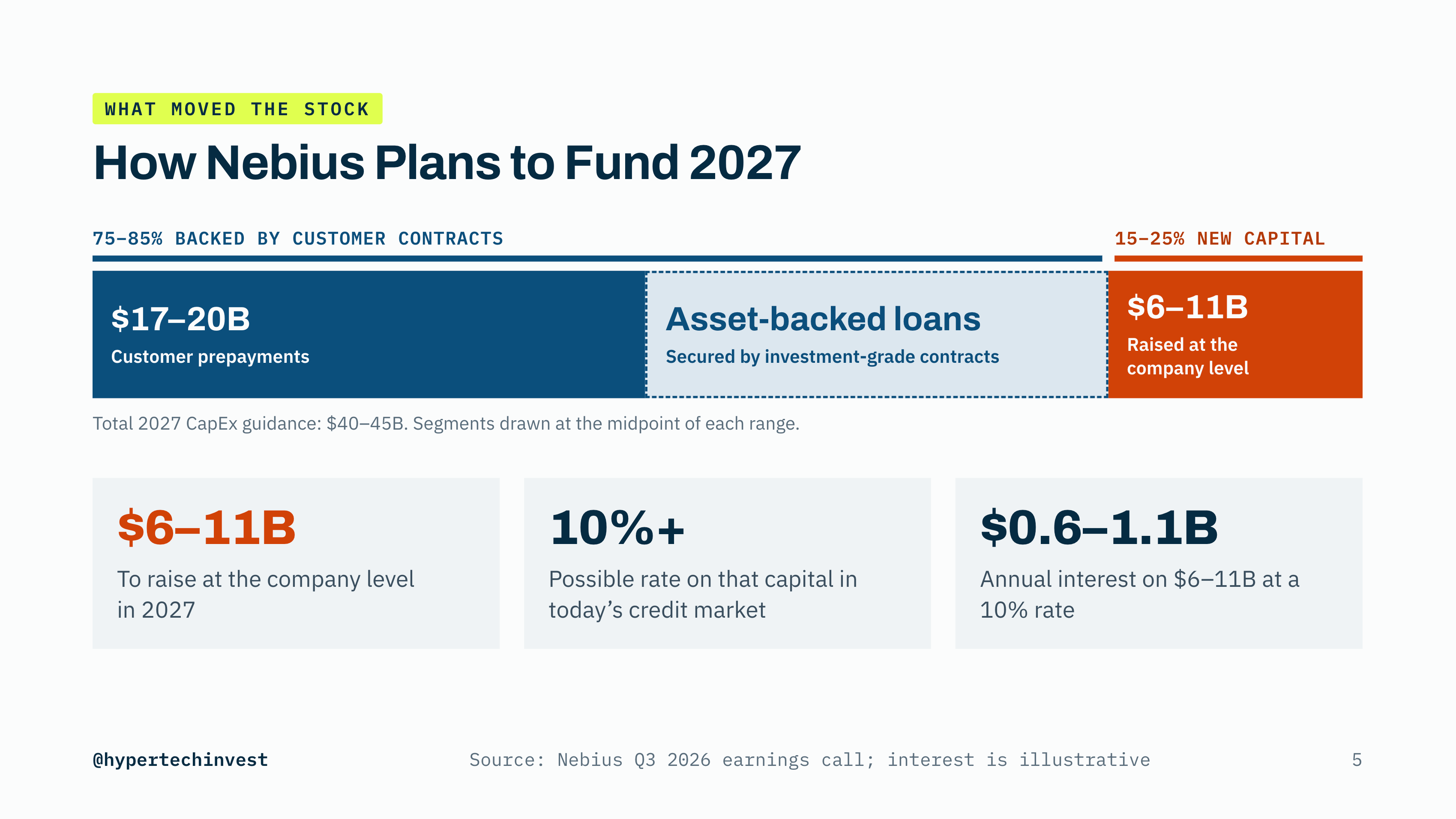
A similar financing plan to IREN’s. However, the question is: What conditions will they get on the $6–11B to be raised at the company level?
Based on what we’re seeing today, rates could be well over 10%. That would put significant pressure on the company’s ROI, and it’s what the market is fearing.
Nebius is very ambitious, and there’s a good chance it may have to cut its CapEx targets and, ultimately, its expansion hopes if the macro doesn’t improve. Alternatively, using the ATM would become a very real possibility.
ARR Discontinuation
One thing the market probably didn’t like was that ARR won’t continue to be guided after February. Management said they don’t build the business with a month-by-month mentality, plus one-time fees from the asset-light business can distort the figure.
I think it makes sense that they want to move away from shorter-term thinking, which is more needed when the company is in a hypergrowth phase and less so when it’s maturing.
However, I believe more transparency is always better, and guiding cloud ARR, on an isolated basis, could still be feasible, leaving out one-offs.
I understand management doesn’t like the noise that ARR can bring, but as a shareholder, I’m against decisions that make the business more opaque for retail investors.
3. The Bright Side
I’ve painted a fairly negative picture. Let’s go with the good part.
1. Demand Is Insatiable
The most important factor for the thesis is demand, especially if it outpaces supply, which is what’s happening at the moment.
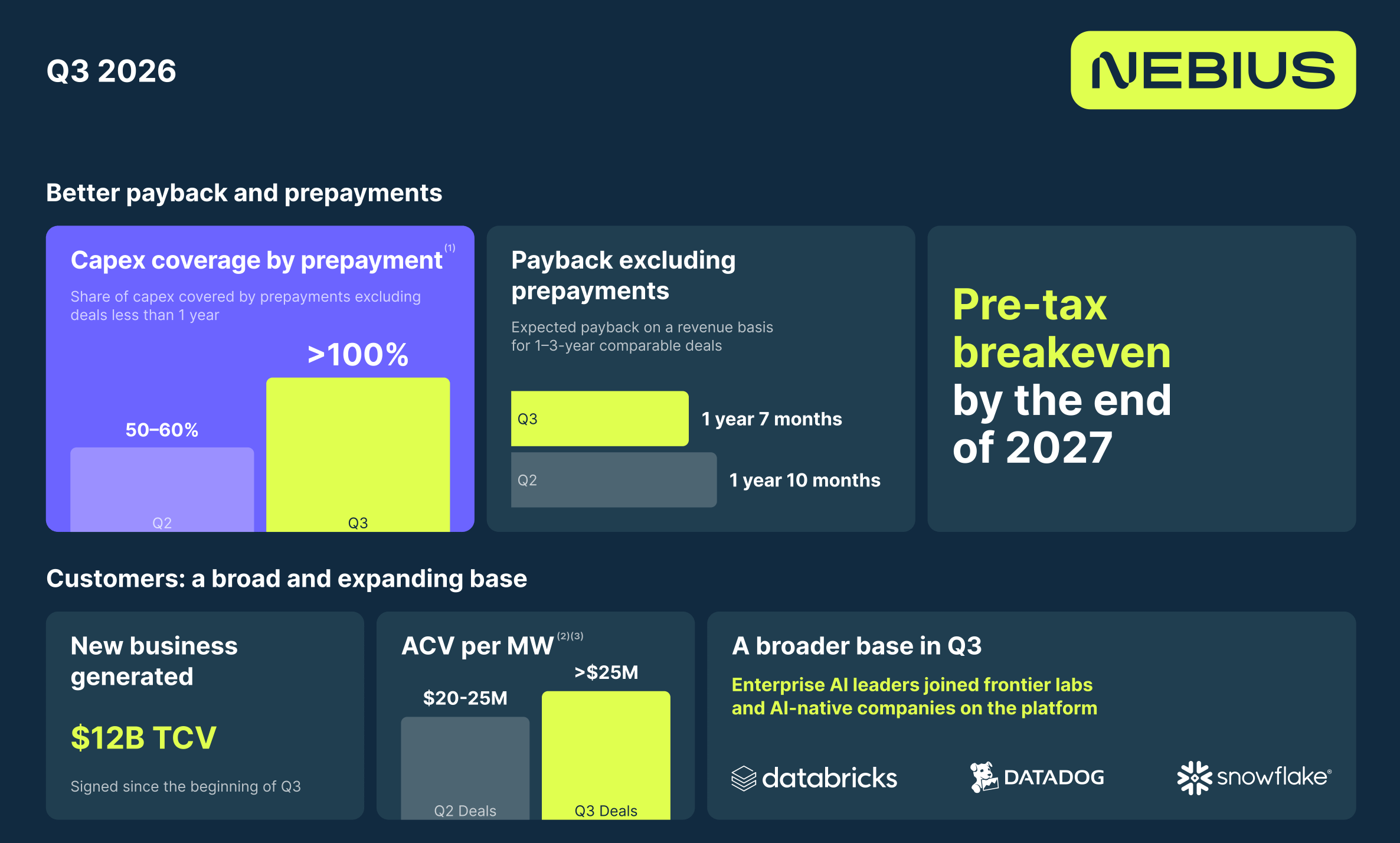
“Demand is strong. Our customers are committing to us for longer, at higher prices, and they’re paying more upfront. Prices kept rising.
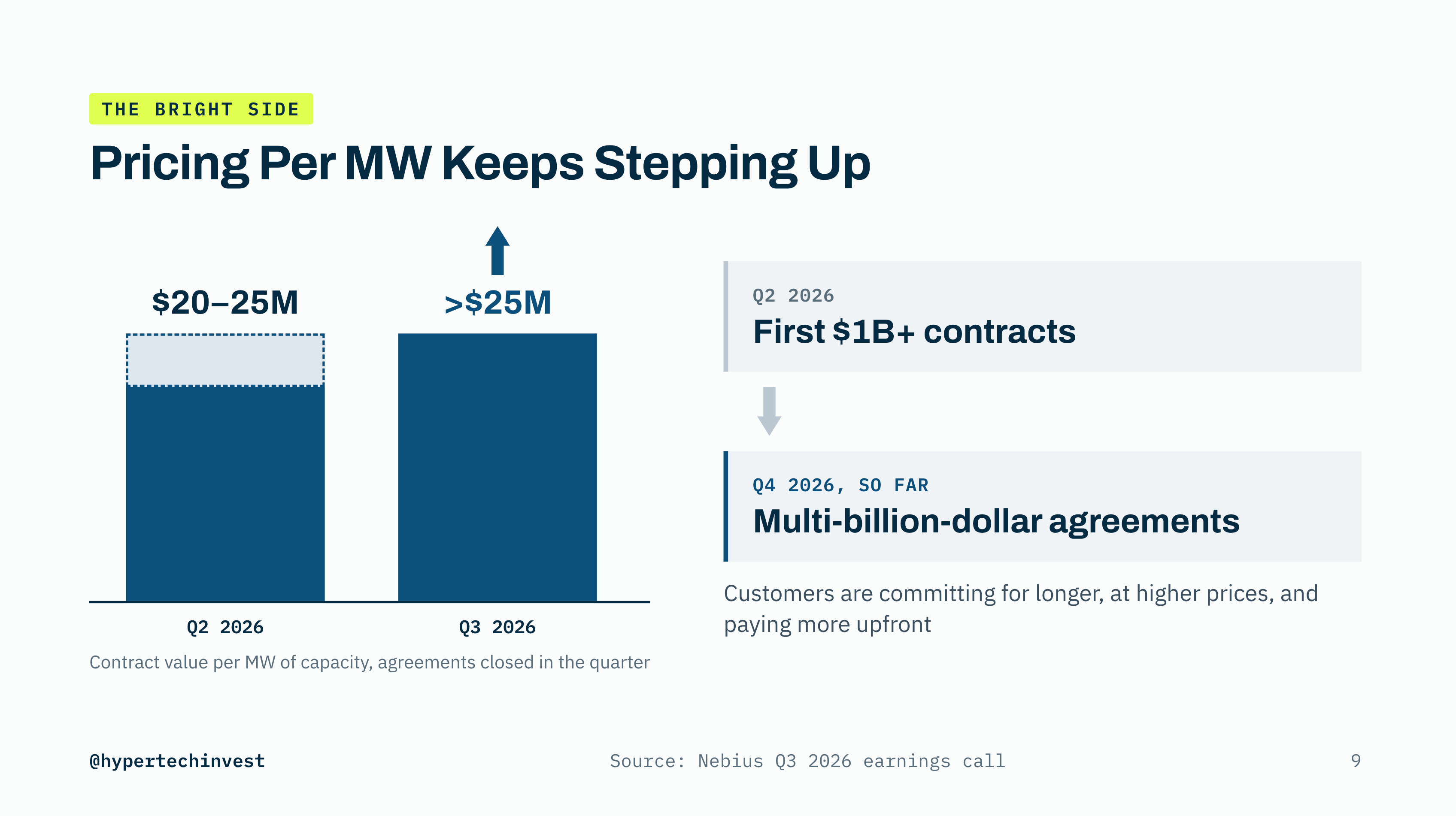
Q3 agreements closed above $25 million per megawatt, another step up from the $20 million-$25 million per megawatt we achieved in Q2. Our customer agreements are getting larger in size.
Three months ago, we reported our first billion-dollar-plus contracts. In Q4, we are already signing multi-billion dollar agreements for our AI cloud.
The base of that demand is broadening too. AI natives are scaling with us. Enterprise AI leaders like Databricks, Datadog, and Snowflake signed multi-year agreements with us for the first time during this quarter.”
— Arkady Volozh, Nebius CEO
Nebius is consistently achieving better MW monetization, more generous prepayments, and a more diversified customer base.
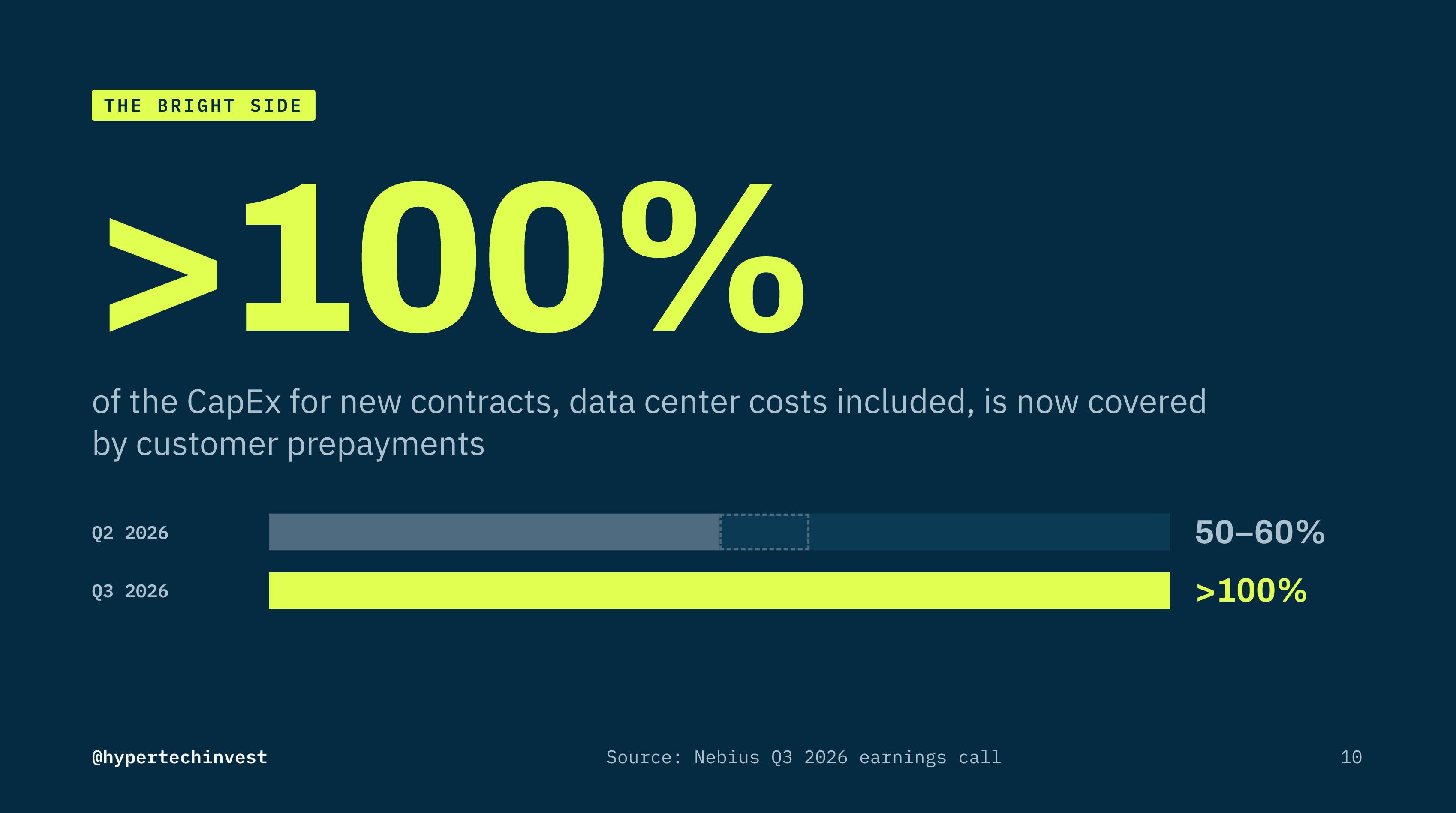
In fact, prepayments are getting so generous that they’re covering even more than 100% of CapEx.
“A customer pays today for capacity that comes online in the next 12 months. Why do they do it? First of all, they want to be sure they reserve their capacity, and they want to reserve today’s price.
The most important change is that the prepayments on new contracts now cover more than 100% of the capital needed to bring this contracted capacity online. Just to remind you, last quarter, it was 50%-60%.
As a result, payback in Q3 shortened to one year and seven months from one year and 10 months a quarter earlier.
Our customers are paying more, they pay earlier, and they are committing for longer, and we are getting our capital back faster.”
— Arkady Volozh, Nebius CEO
One reason, as Arkady says, is to reserve capacity at a fixed price, but there are more reasons:
“First, we are recognized as a market-leading platform, sought by AI builders who are willing to pay a premium for our reliability and service.
Second, we said last quarter that we have the demand and could sell all our capacity at current terms, but instead, we were holding back to secure better terms, and we were able to do so.
That is what we are experiencing now as we have raised prices, expanded prepayments simultaneously.
Third, our absolute dollar amount of the prepayment translates to higher percentages of CapEx due to our overall approach to managing our cost structure to a lower absolute value.
Higher prepayments and lower costs has resulted this quarter in greater than 100% coverage of the full CapEx, including data center costs.”
— Marc Boroditsky, CRO
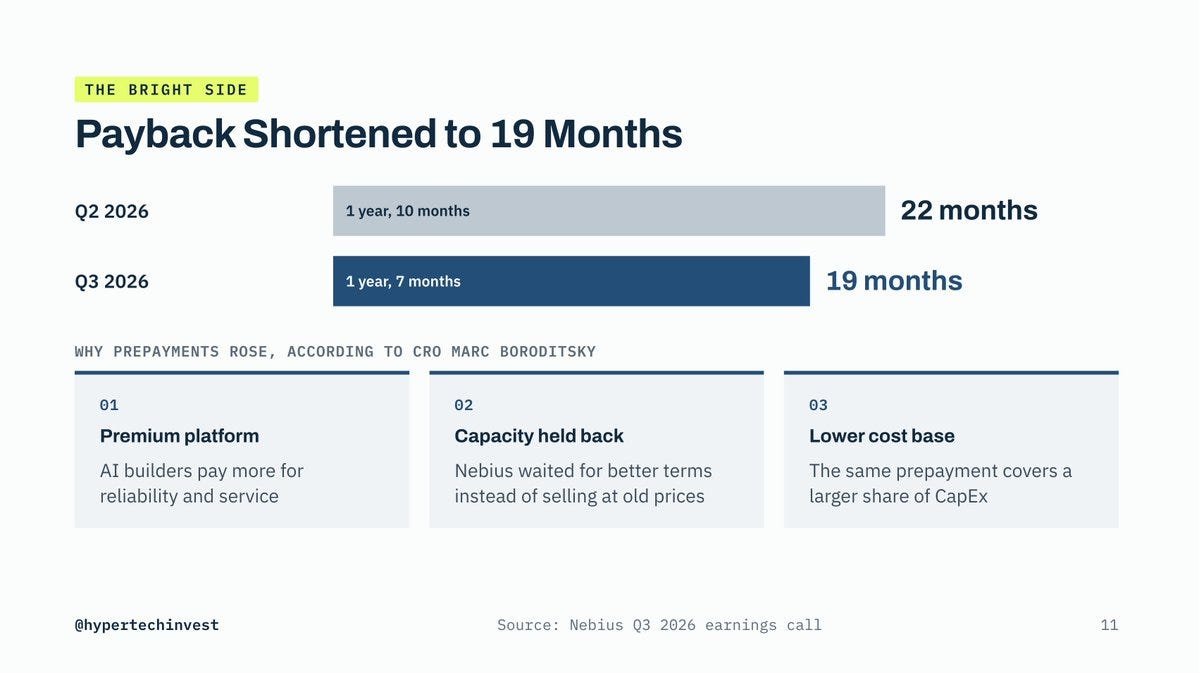
In summary, demand is so high, and Nebius is such a credible operator, that they’re in a prime position to benefit from customer-funded expansion that drastically reduces their cost of financing and brings down the payback period on CapEx to as low as 1 year and 7 months, as reported this quarter.
2. Equipment for 2027 Is Secured
This may not seem as important, but with an undersupplied industry for Vera Rubin, making sure you get your piece of the cake means you can extract the rents of a constrained market:
“If we talk about the new generations and new chips that will come online in 2027, Vera CPUs, Vera Rubin GPUs, and Groq. We already have all the R&D integration and tests and benchmarks already done.
We are very good to go from the technical standpoint.
From the supply chain standpoint, we have confirmed all the supply for 2027.
We are, again, here, we are also very confident in our execution.”
— Andrey Korolenko, CIPO and Co-founder
3. Nebius’ Platform Keeps Expanding
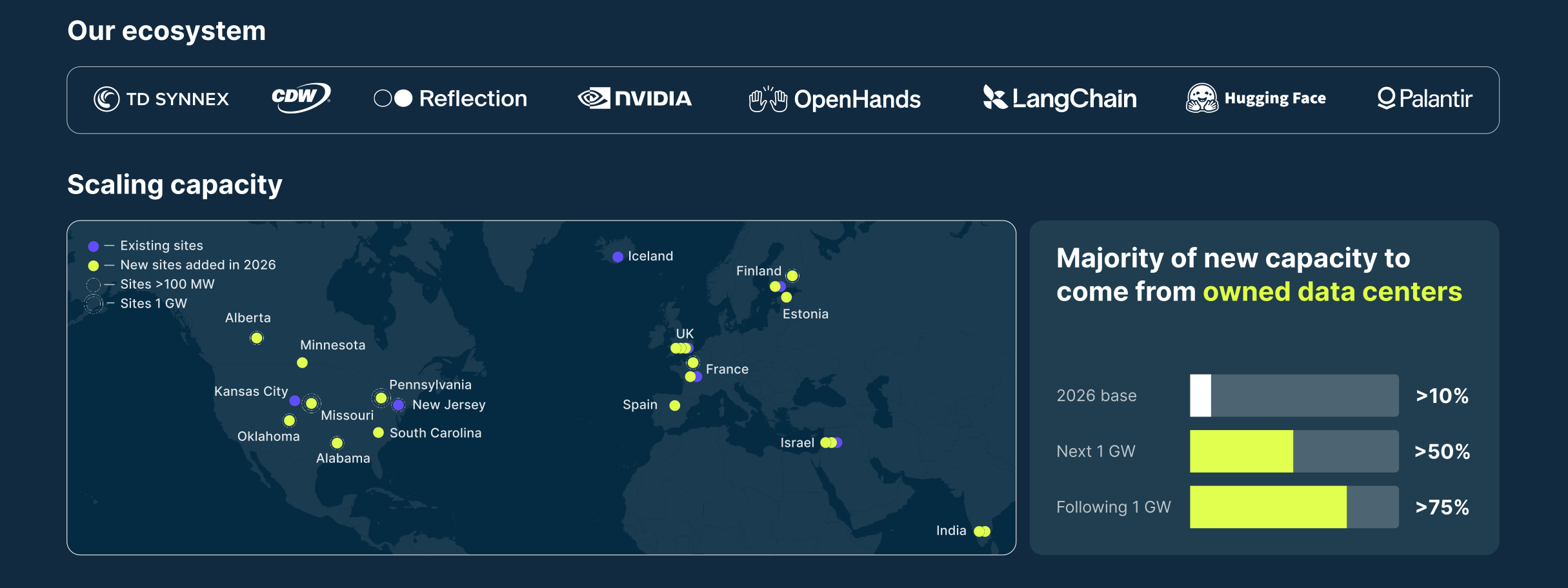
Databricks, Datadog, Snowflake, and Palantir have signed multi-year agreements with Nebius, which, according to management, shows the strength of Nebius’ offerings through its Token Factory platform.
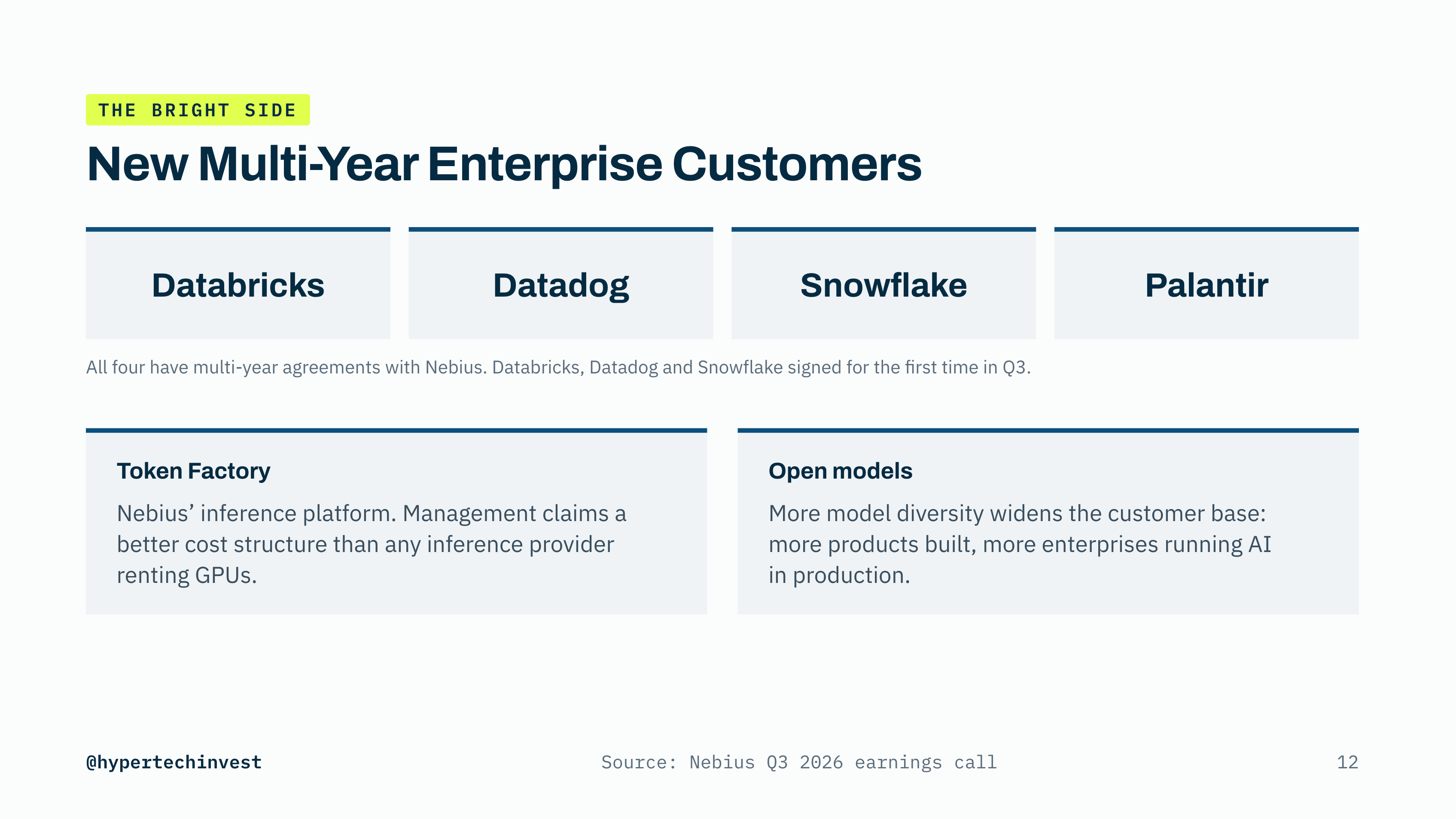
In fact, Nebius management said:
“We have much better cost structure than any inference provider renting GPUs.”
Regarding open-source models, Nebius sees them as an opportunity:
“This diversification comes from open models or other ways to build specialized models for the particular use cases.
Again, why it’s good for Nebius?
Because it extends the universe of customers and partners we can work with and the value we can create.
More new products are built, more enterprises bring AI into the production, and we will continue supporting this adoption of the diversified models across the ecosystem.”
— Roman Cherrin, CBO and Co-founder
4. Q4 2027 Profitability
Nebius now expects to reach break-even on a pre-tax earnings basis in Q4 2027, assuming five-year depreciation of servers and network equipment, as the company’s own sites ramp up throughout the year.
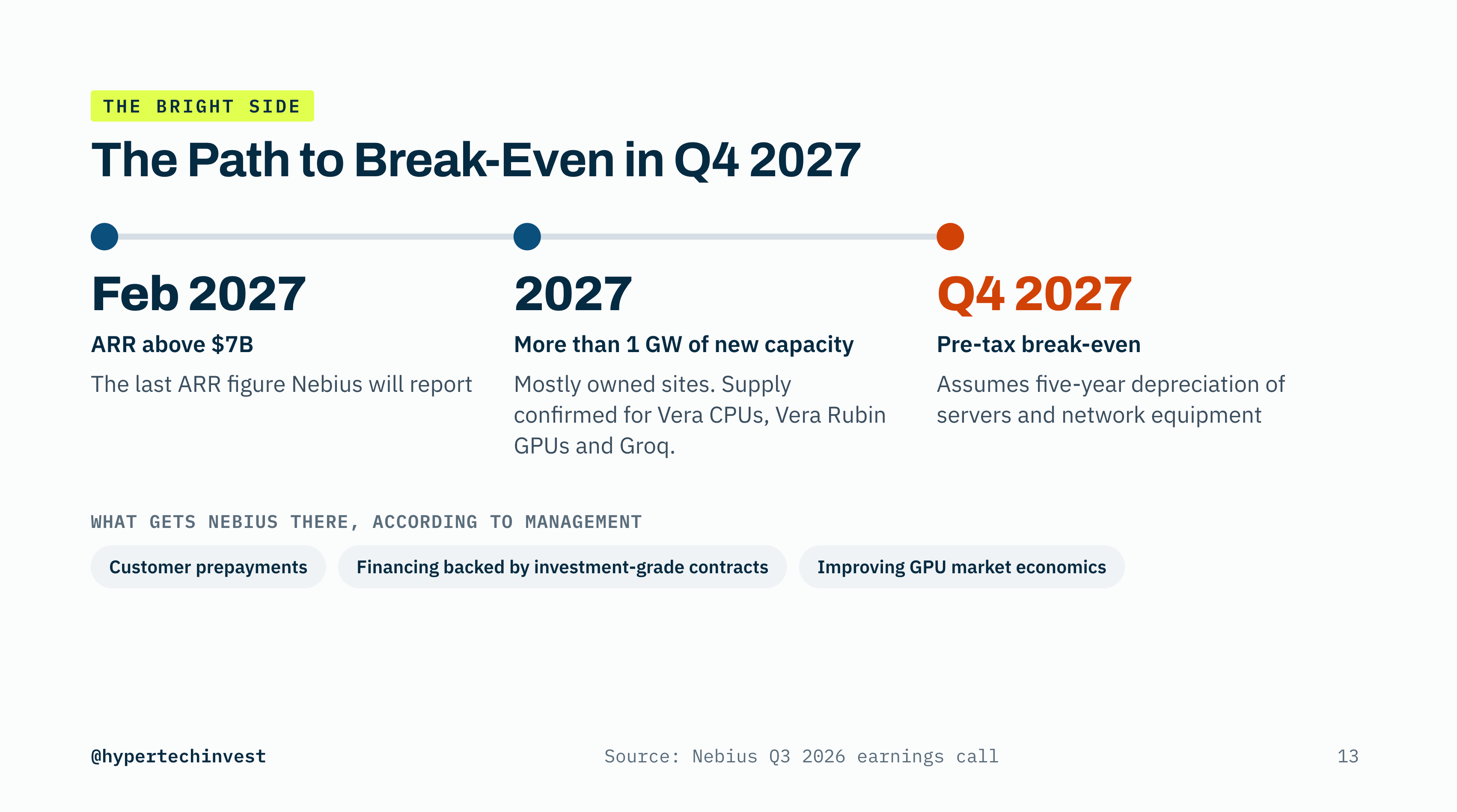
Arkady mentioned that prepayments, investment-grade contract-backed financing, and improving GPU market economics are what will take Nebius to profitability, which would be a massive milestone for a company as young as Nebius.
The Elephant in the Data Center Hall
The market isn’t happy about Jensen leaving.
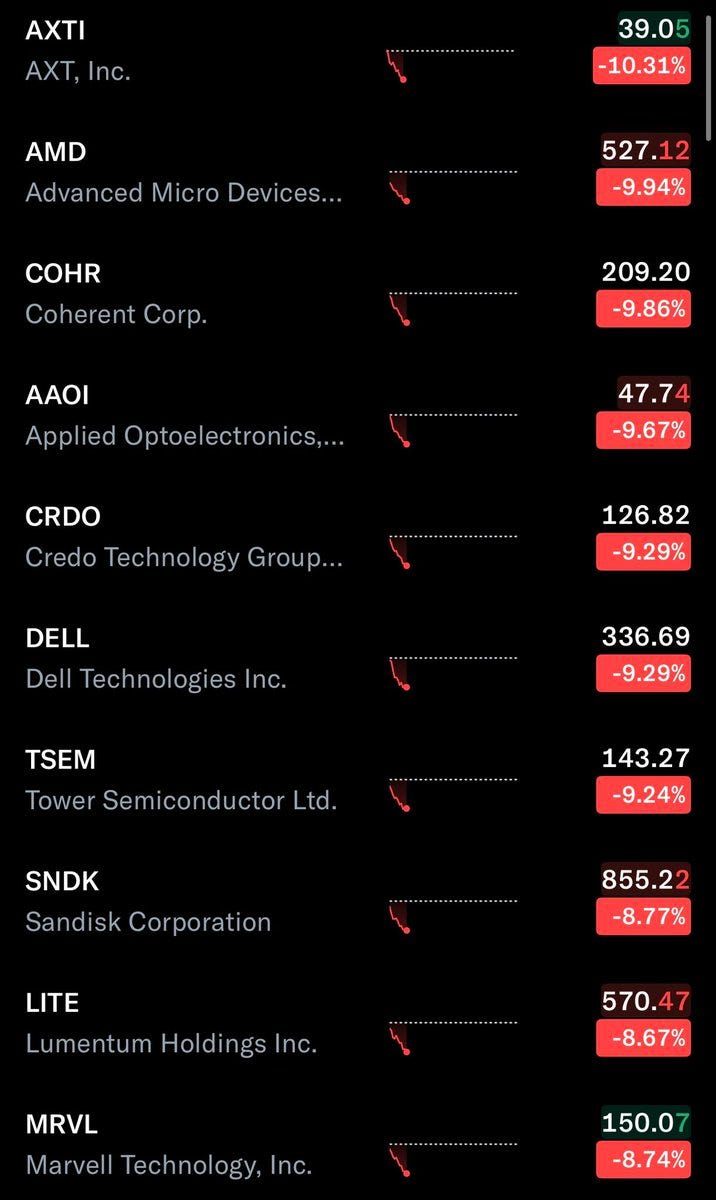
As if a war in the Middle East, inflation, AI doomerism, regulation, and anti-data center sentiment weren’t enough, now we have to deal with the departure of the most important person in the entire AI industry. The man who built the largest company on Earth, who single-handedly created the neocloud industry by purposely diversifying NVIDIA’s customer base, and the most charismatic, influential, and, as proven by his history, resourceful CEO in the semiconductor industry.
I don’t particularly like Jensen as a person, but it’d be foolish to ignore his genius. This is a massive hit for the industry, but at the same time, AI is much, much bigger than a single person. While the consequences of this will probably be felt for years, that doesn’t stop the progress of technology.
How Could This Affect the Neoclouds?

NVIDIA’s new interim CEO, Colette Kress, is known for her more conservative approach and reluctance to fall for what the market has labeled the “circular economy.”
So, yes, I think we will see fewer investments by NVIDIA in other companies, but is that so important? I don’t think so. NVIDIA hasn’t played a massive role in funding these companies. The biggest factor is GPU allocation.
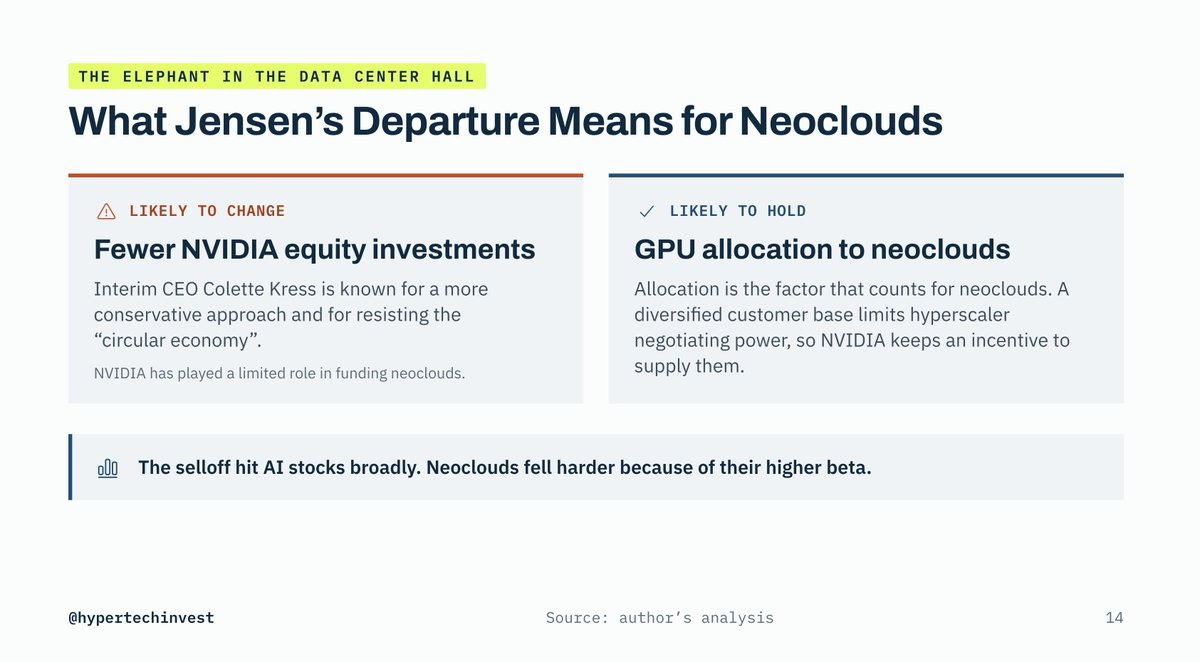
Jensen was a massive proponent of the neoclouds. We don’t know if the new leadership will be as well, but logic says they will. At the end of the day, what company prefers having a more concentrated customer base with more negotiating power?
So, while some people think this is much worse, especially for neoclouds, I think the market doesn’t even agree with that. We’re seeing stocks go down across the AI industry. Neoclouds simply have higher beta, but on a fundamental level, this is not a very significant situation, particularly for companies like Nebius.