


Index Brief
1. Space Superiority Order
2. Companies
3. Conclusion
4. What I’m Doing
5. Other Space Stocks
6. Next Articles
Space Superiority Order
In the executive order from December 18, an ambitious plan for space dominance and exploration was laid out by President Donald Trump.

These are the main plans:
Return Americans to the Moon by 2028 through the Artemis Program
Build initial elements of a permanent lunar outpost by 2030
Attract at least $50B of additional U.S. space investment by 2028, while increasing launch and reentry cadence through facility expansion and policy reforms
Push spectrum leadership to boost competitiveness and market access
Create a commercial pathway to replace the ISS by 2030
Enable space nuclear power, including reactors on the Moon and in orbit, with a lunar surface reactor ready for launch by 2030
Improve space and Earth weather forecasting and operations, using firm fixed-price and as-a-service contracting models
NASA’s Budget
However, narrative and funding are two very different things.
The President’s FY2026 NASA budget request represents a major cut. NASA’s total budget would drop from $24.84B in FY2025 to $18.81B.
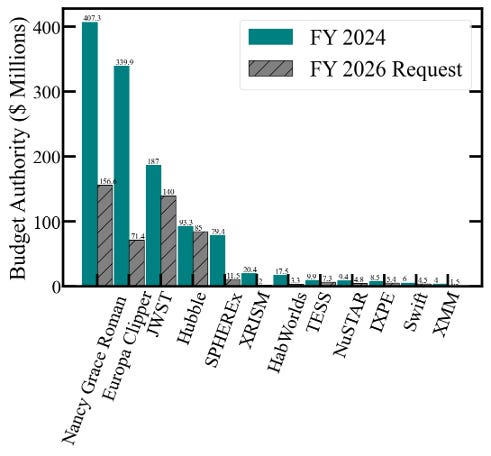
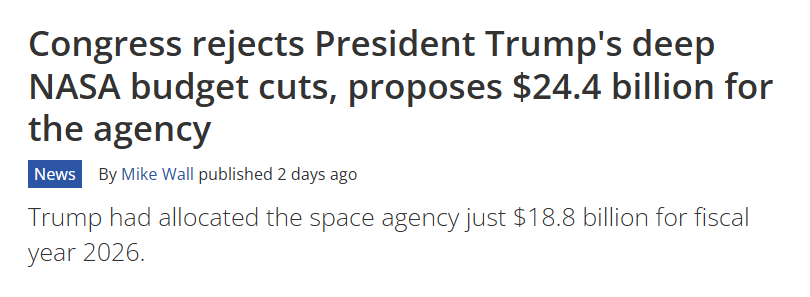
Congress is pushing back, floating a number closer to flat funding, still slightly below FY2025, at around $24.44B.
Commercial First
While this may appear bearish, there is an important caveat.
The December 18, 2025 space executive order fundamentally changes how contracts are awarded, and where the funding is coming from as well.
Within 180 days, NASA and the Department of Commerce must reform space procurement. The default shifts to commercial solutions first, rather than custom government systems. Agencies are directed to prefer OTAs and Space Act Agreements and to accept standard commercial terms.
The order explicitly favors:
Firm fixed-price contracts over cost-plus
As-a-service models over government-owned hardware
Purchasing existing commercial capabilities when available
The executive order also mandates a review of underperforming programs. Agencies must identify and remediate any space program that:
Is more than 30% behind schedule
Is more than 30% over budget
Misses key performance requirements
Is misaligned with commercial-first priorities
This framework is reinforced by an April 15, 2025 government-wide procurement order, directing agencies to buy commercial products and services to the maximum extent practicable.

The order also calls for accelerated acquisition reform, deeper integration of commercial space capabilities, and expanded access for new market entrants, with the goal of attracting $50b in external investments as well.
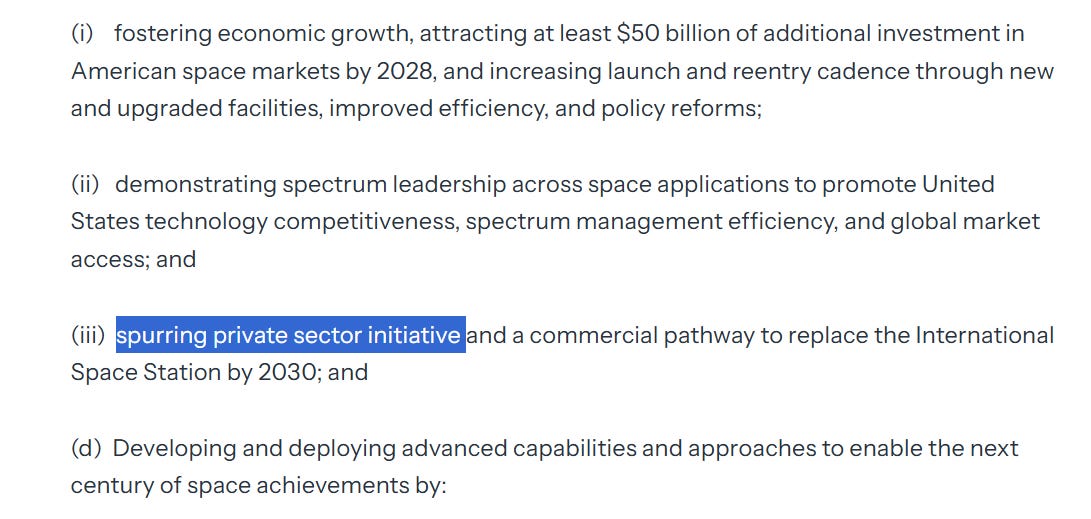
What this means is that, even if the overall budget ends up slightly lower assuming Congress passes a near-flat allocation, a larger share of spending will flow to private companies, rather than internal NASA programs.
So unless the President’s proposed budget, with deep spending cuts, actually passes, which is unlikely, we could see more contracts awarded to more companies.
Small Cap Opportunities
That is where small-cap space companies become a far more interesting opportunity.

Which companies stand to benefit most from:
Moon colonization
A commercial space station
Space nuclear power
Orbital and lunar data centers