

Galaxy is quietly becoming a giant in both the crypto and data center sectors. Perfectly positioned in these two explosive themes, I believe Galaxy is on its way to becoming a multibagger from its current 10 billion dollar market cap, which in retrospect will look fairly obvious.
In this article I will go over their business and explain why I believe Galaxy is one of the clearest opportunities in the market, hiding in plain sight.
Crypto Business
Galaxy is often referred to as the Goldman Sachs of crypto, and this is not far from reality. They offer a complete platform for institutions that want to get involved with digital assets, from managing buys and sells to providing secure custody products.
Their strong reputation is what brought clients like Goldman Sachs, Tom Lee’s Bitmine, SharpLink, a partnership with Invesco for a Bitcoin ETF, SoFi, and even FTX before its collapse.
Digital Asset Services
They make money primarily through management fees and direct payment for their institutional services.
They hold a significant moat in this space. No competitor matches their prestige, expertise, or track record, and this moat continues to expand. Here is some growth data from the last quarter:
Record trading volumes, up 140% quarter over quarter, including the execution of more than 80,000 BTC for a client
Average loan book of 1.768 billion dollars, up 60% quarter over quarter and 105% year over year
Digital Assets Adjusted EBITDA of 250 million dollars, up from 13 million dollars, which represents more than 1,800% growth
Assets under management of nearly 9 billion dollars in Q3 2025, up from 4.608 billion dollars in Q3 2024, roughly 90% growth
Assets under stake of 6.61 billion dollars in Q3 2025 versus 3.394 billion dollars in Q3 2024, about 95% growth
This digital asset figure excludes gains from asset appreciation, which often distort company-wide results. Even without those gains, profitability is very impressive for a company with a 10 billion dollar market cap.
While the company trades at roughly 11x annualized EBITDA and grows at high rates, I would not say it is the cheapest business in the market. Crypto is unstable and cyclical, and Galaxy benefited from a unique quarter where the largest Ethereum and Solana treasuries used them as an intermediary and custodian. That level of activity will not necessarily stay at the same volume forever.
Still, if you believe in crypto, it is hard not to be bullish on Galaxy. Their loan business is accelerating, and the industry narrative around tokenization from firms like JPMorgan and BlackRock aligns perfectly with Galaxy’s infrastructure. They own a platform that allows institutions to hold crypto and tokenize assets in a secure and efficient way.

This is pure TAM expansion, and there is no company better than Galaxy for institutional crypto services. If everything will be tokenized, as Larry Fink likes to say, this looks very bullish for a firm like Galaxy.

I am not projecting that 1 billion dollars per year in adjusted EBITDA from their crypto business is guaranteed, but with a 5 year timeframe, I would be very surprised if it has not gone far beyond that. This makes me think you could comfortably justify the company’s 10 billion dollar market cap with this segment alone.
They also expanded their services to retail, which significantly increases their TAM in a market I am very bullish on.
Retail Offerings: GalaxyOne
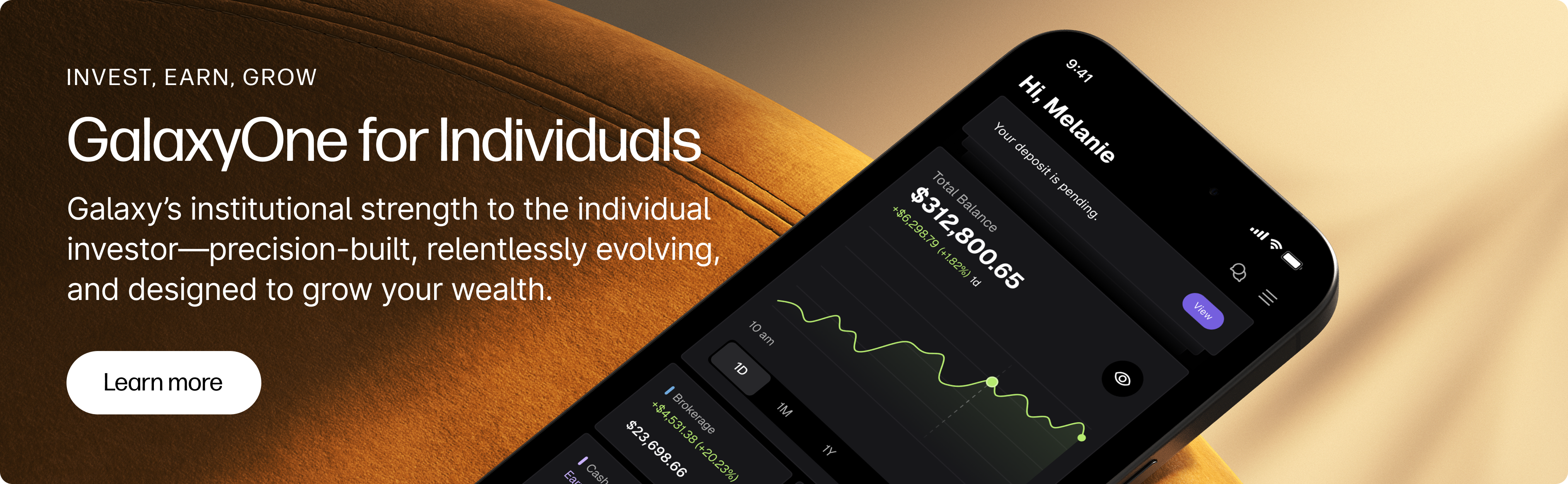
GalaxyOne is a single app where a U.S. user can hold FDIC-insured 4.00% APY cash, buy and sell U.S. stocks and ETFs with zero commissions, and trade major crypto such as bitcoin, ether, and solana. GalaxyOne runs on the Fierce consumer platform that Galaxy acquired in 2024.
The goal is to place cash, crypto, and equities under one login and bring Galaxy’s institutional capabilities to individuals. That means one KYC, one wallet, one funding flow, and multiple products that work together instead of living in separate apps. Galaxy positions this as a tool for serious investors, not a gamified trading experience.
Galaxy has been clear about its long term vision where the crypto ecosystem gradually takes over consumer finance, and their goals reflect that ambition:
Turn GalaxyOne into a full wealth account where users hold cash, hold and stake crypto, trade equities, and later access tokenized funds and other regulated products through the same interface
Use the unified design to raise funding balances with 4% cash and then cross sell trading, staking, and yield, all supported by Galaxy’s custody, trading, and risk systems
Keep the experience institutional grade while remaining simple for individuals, which is a key part of their launch strategy and earnings commentary
This new offering sits at the intersection of multiple themes I am bullish on. It benefits from tokenization, retail crypto adoption, and institutional backed platforms that can earn consumer trust in a market full of scams.
Investments and Treasury
Galaxy is not only about services and fees. They also have skin in the game.
Their main investments include:
Bitcoin: 546 million dollars
Ether: 258 million dollars
Solana: 251 million dollars, including their stake in Forward Industries
Other digital assets: 250 million dollars
Venture and fund investments: 646 million dollars
Public equities and other liquid holdings: 191 million dollars
In that 191 million dollar public equity portfolio, they own positions in Bitmine, SharpLink, and Bullish, which is backed by Peter Thiel.
Galaxy also operates two main arms for smaller and early stage investments: Galaxy Ventures and Galaxy Interactive.
Galaxy Ventures focuses on crypto infrastructure, protocols, payments, stablecoins, and developer tools.
Galaxy Interactive focuses on gaming, creator tools, interactive technology, and the compute stack behind these industries.
Most of the 646 million dollars in venture value comes from these two divisions.
Galaxy Ventures
Galaxy’s venture portfolio includes investments in:
Turnkey: embedded wallets with automated on chain actions
Monad: high performance EVM Layer 1
Plume: Layer 2 focused on real world assets
Ethena: synthetic dollar and yield protocol
M^0: non custodial stablecoin infrastructure
Rain: enterprise stablecoin payments platform that raised 58 million dollars
Rail: global stablecoin settlement network
RedotPay: stablecoin cards and merchant payments
Yellow Card: pan African regulated exchange and payments company
Arch Lending: institutional crypto credit platform
1Money: stablecoin payments and wallets
Polygon Labs: Ethereum scaling stack
EigenLayer: restaking marketplace
Celestia: modular data availability
Axelar: cross chain messaging
Hyperlane: permissionless interoperability
RISC Zero: zk VM for verifiable compute
Gensyn: decentralized AI compute marketplace
Pyth: low latency oracle network
Centrifuge: tokenized real world assets
Superstate: tokenized investment funds
Mesh: account connectivity and money movement
Talos: institutional trading platform
Fireblocks: custody and settlement infrastructure
TaxBit: digital asset tax and accounting
Messari: crypto data and research
Certora: formal verification
PoolTogether: prize savings protocol
Staking Rewards: staking data platform
With Galaxy you are getting a diversified conglomerate within the crypto sector that is already profitable, generating 250 million dollars in EBITDA last quarter. As a risk adverse way to gain exposure to smaller scale projects in the industry, Galaxy stands out as the strongest option. You are placing capital in a cash generating business run by experts who reinvest that cash in the wider ecosystem and in their data center expansion.
Data Center Segment
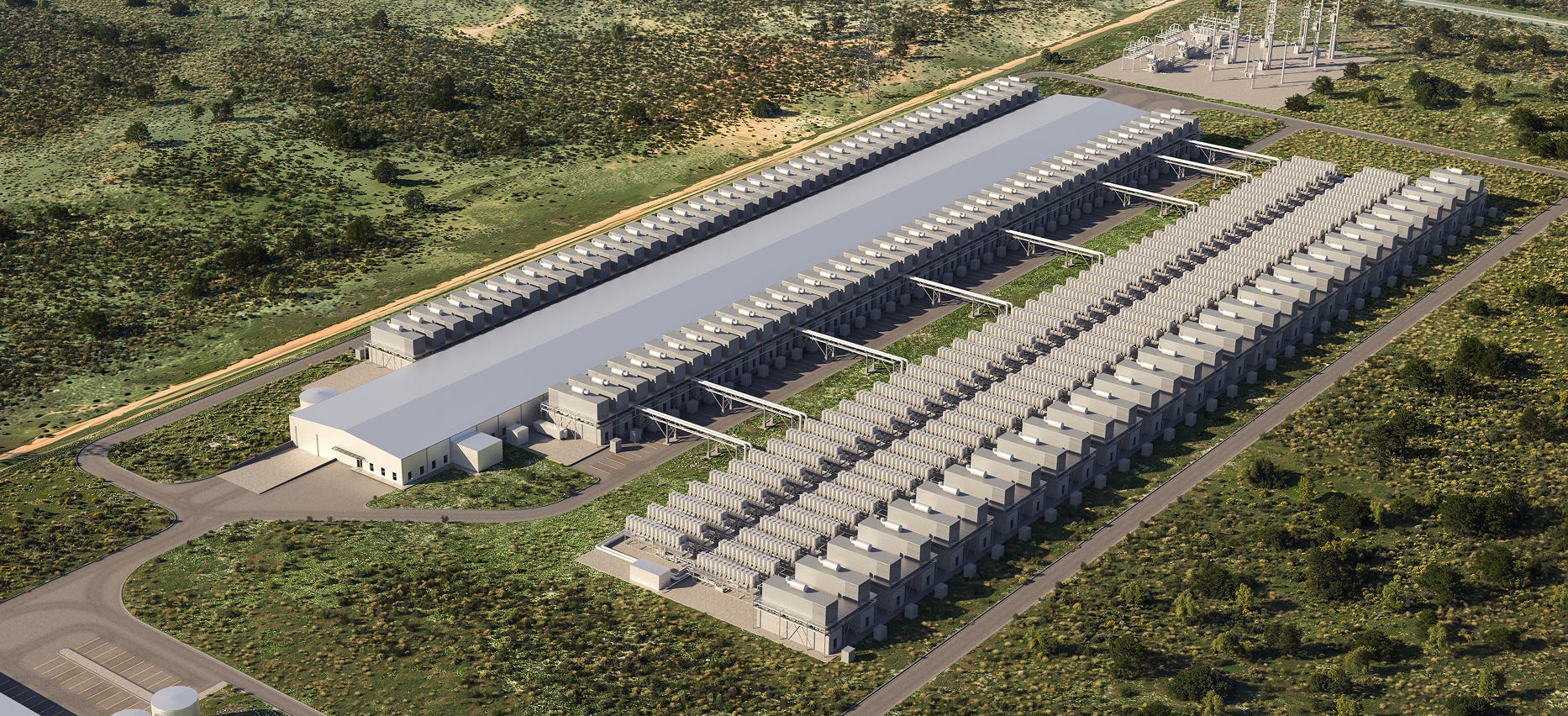
Galaxy had remarkable luck with its data center ventures. In May 2022, Argo had just completed Helios, a large Bitcoin mining facility in Dickens County, Texas, designed for 800 megawatts of power. When the crypto market collapsed later that year, Argo ran out of liquidity. Their loans were coming due, energy prices were high, and they could not keep up with debt obligations. They began looking for buyers or financing partners to avoid bankruptcy.
Galaxy Digital stepped in. In December 2022, Galaxy bought the entire Helios facility from Argo for about 65 million dollars and provided 35 million dollars in secured financing so Argo could pay its lenders. This gave Argo breathing room while Galaxy acquired a fully operational site with enormous expansion potential.
At that point, Galaxy was already one of the largest institutional players in Bitcoin mining and digital infrastructure, making Helios a natural fit within their strategy.
When the AI boom began, Galaxy realized that a site originally intended for mining was far more valuable as HPC infrastructure. After redesigning the site for high performance computing, they signed a massive long term agreement in 2025 with CoreWeave, leasing out the entire 800 megawatt capacity for AI and HPC workloads. They also secured 1.4 billion dollars in project financing to fund the build out.
The 800 megawatts will be delivered in stages through 2028. Once all capacity is active, Galaxy will generate over 1 billion dollars in revenue with 90% EBITDA margins. This means that Helios alone values Galaxy at roughly 13x 2028 EBITDA.
Extra Capacity: A massive catalyst
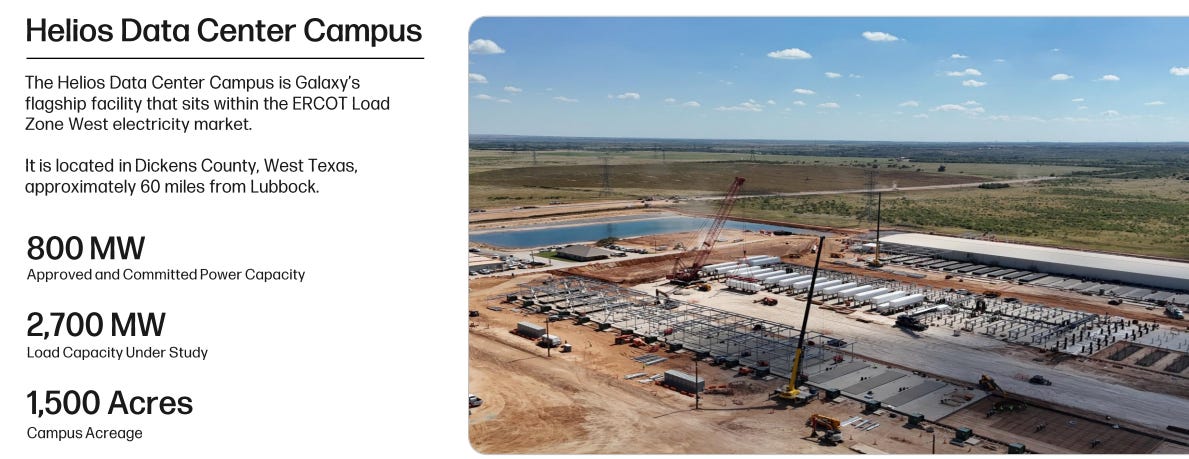
And it gets even better. Galaxy plans to build a massive data center campus in what is becoming the global hub for AI, West Texas. They are under review for 2.7 gigawatts of additional capacity, which gives them a very strong catalyst. If approved, they would become the public company, excluding hyperscalers, with the largest approved capacity in the market.
This expansion is supported by their crypto operations, and to cover the remaining capital needs they raised 1.4 billion dollars through with a project debt facility on very attractive terms. The notes carry a 0.5% annual coupon with an exchange price of 55.76 dollars per share, which reflects strong confidence from investors.
Another positive factor is the quality of their management, which shows up in the strength of the deal they negotiated. Among all their peers, Galaxy secured the best terms in their contract with CoreWeave.

Galaxy has a very compelling business. In their crypto segment, they generate recurring revenue through ETF fees, asset management, and additional income from trading and advisory services. They are also expanding their TAM through crypto backed loans and their new retail products, which management is very bullish on.
This segment is high margin, with 79% EBITDA on their net fees. They are already well financed for the first phase of Helios going online in H1 2026, which will bring more than 200 million dollars in adjusted EBITDA.
With these cash inflows, they can reinvest into more buildouts, along with their venture and strategic investments. Over time, these investments will compound. Galaxy is positioned for explosive growth during the next 2 to 3 years, and after that it can become a very strong compounder. If you are bullish on both crypto and data centers, there are very few companies that make more sense for a portfolio. You get two businesses that, even with cyclicality, will almost certainly generate more than 2 billion dollars in EBITDA by 2028, plus the upside from their other investments, all for a 10 billion dollar market cap. It looks unreasonably cheap.
Risks

Does the company come with risks?
Yes, and I see three main ones:
Operational risk on the data center side. Galaxy is hiring strong talent, but they have never built a data center before. If you buy Galaxy, you are betting they will deliver their first large scale build correctly on the first attempt.
Crypto winter. A deep crypto winter would erase most of the upside for this company, no matter how well Helios performs. AUM would fall, and in dollar terms it would fall even faster. Their investments would lose equity value quickly and their fee revenue would drop. Even Helios would not be enough to offset the mid term impact of a severe downturn. Investors need to be comfortable with high crypto exposure and live with that volatility.
Customer concentration. All current Helios capacity is tied to CoreWeave. CoreWeave has raised concerns on Wall Street due to large debt, heavy depreciation, and reliance on Core Scientific. Even though I believe that if CoreWeave failed the capacity would be picked up quickly by another partner, the market would clearly prefer a hyperscaler client.
As with any stock I cover, if you enter this position you should have a long term mindset. Nobody can predict market cycles accurately. Yes, you can always find a few people who timed things well, but for every one of them there are ninety nine who did not. Probability makes timing a losing strategy, and it should not guide your approach.
Valuation
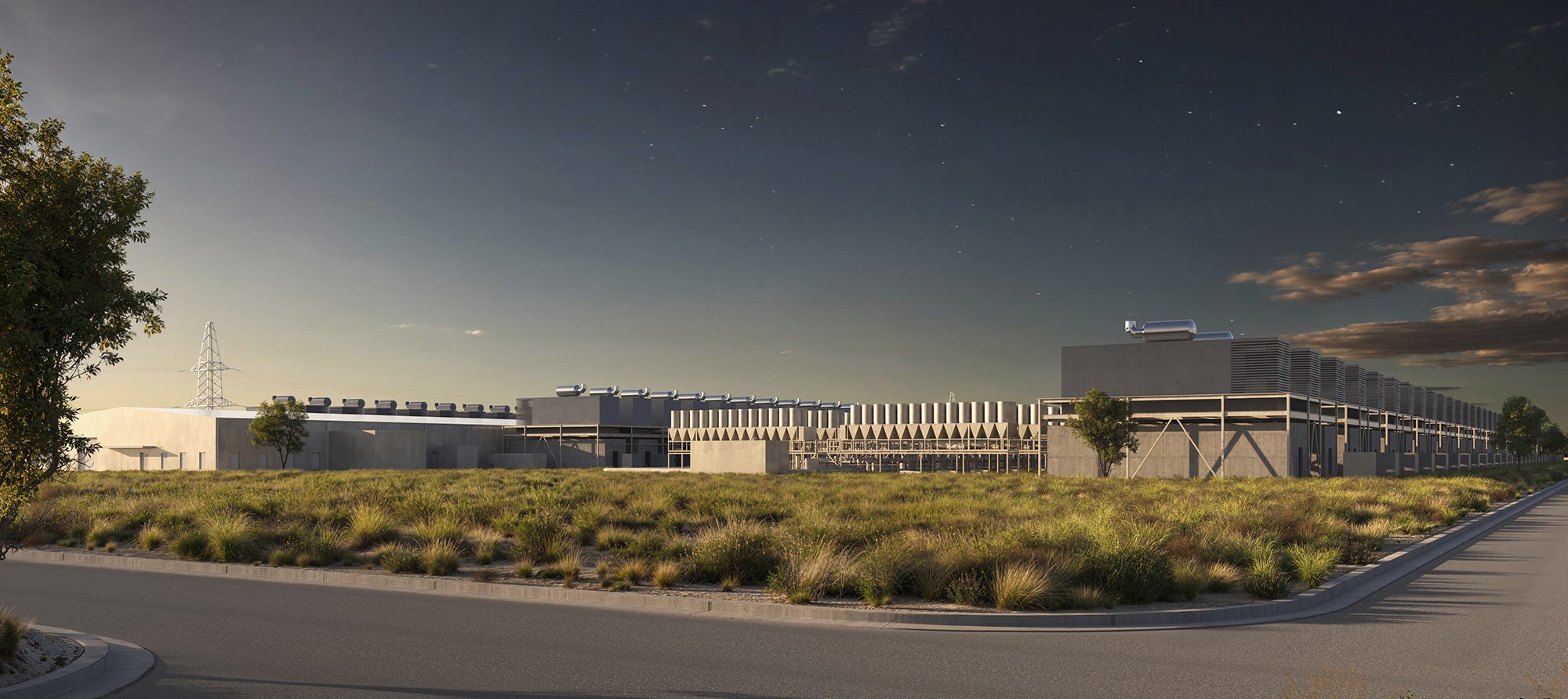
Galaxy is building a high quality compounder with two massive thematic drivers: crypto and compute.
They are on track to generate more than 2 billion dollars in adjusted EBITDA by 2028 at the latest, and they could secure an even larger campus if the new capacity is approved. Apply a 25x multiple on that EBITDA and you get a 50 billion dollar valuation.
Even with 10% dilution along the way, you still get multibagger returns from the current 10 billion dollar enterprise value in two or three years.
What if they get the extra 2.7 gigawatts approved? That would bring 5 to 8 billion dollars in revenue and 4 to 7 billion dollars in EBITDA. Debt and some dilution from convertibles would likely be needed to fund the buildout, but once Helios is fully running, they will have a free cash flow machine that prints money and will be better positioned to execute this type of expansion than most peers.
Short term Outlook
As much as I like the company as a long term investor, everyone should keep in mind that Galaxy is heavily dependent on crypto, which means current weakness in the sector will hurt Q4 results. I do not try to time these short term moves, and I do not have any edge here because the market already understands Galaxy’s business. Most of this is already priced in. My focus remains on a long term vision, not on finding the perfect entry.